
The Use of Informers in First Fleet Society
Gary L. Sturgess
7/6/20264 min read
It is generally (but wrongly) understood that order was maintained in First Fleet society by the 210 marines assigned to the NSW garrison. But their duty was to protect the settlement against attack and prevent an uprising, not to serve as prison guards or convict overseers.
The commanding officer of the marines, Major Robert Ross, did have responsibility for the preservation of order and the prosecution of crime, in his capacity as Lieutenant-Governor. On landing, Governor Arthur Phillip asked Ross to manage the western side of the settlement, where the greatest number of convicts and marines were housed.
The ‘camp’ (as the village was then known) was divided by a watercourse (later known as the Tank Stream), and until a wooden bridge was installed in October 1788 (in what is now Bridge Street), the two halves of the settlement operated somewhat independently. In the first 12 months ashore, Ross occasionally drew on the marines to assist him in maintaining order on the western side, but he had a number of others on whom he could rely.
On first going ashore, the primary responsibility for enforcing orders outside the marine encampment lay with the Provost-Marshal, a civil officer, and two constables who worked for him, one of them free, the other a convict still serving his time. And from August 1789, a nightwatch composed entirely of convicts was charged with ensuring that the curfew was enforced and with investigating crime.
In the modern world, imposing perimeter fences, locked doors and (less frequently today) guard towers are crucial to prison security. But electronic surveillance and old-fashioned human intelligence are also fundamental in the early detection of criminal activity and the prevention of disturbances and escapes.
As it turns out, human intelligence was also necessary in managing the penal colony established at Sydney Cove in January 1788. Throughout that year and the next, Major Ross relied heavily on an educated, middle-class convict named Herbert Keeling, whom he described as ‘the man among [the convicts] in whom I place my chief, indeed my only confidence, and from whom I obtain my chief information’. [2]
Keeling did not work for Ross. At the time the Lieutenant Governor wrote that letter, Keeling was employed as assistant to the surveyor-general, and while Ross was using him in managing the convict camps, Keeling was collecting intelligence about his fellow convicts in an unofficial capacity. There can be no question that he was drawing a variety of different informers.
John Herbert Keeling had grown up in one of the more prosperous parts of London’s West End, the son of a gentleman who had sufficient capital that he did not need to work.
Keeling was, Ross said, ‘a man of education’. Young Herbert had joined the Royal Navy as a midshipman, a young gentleman, during the American War of Independence, and after coming home from the war in 1782, he was caught stealing a sword and sentenced to transportation.
The following year, he played an active part seizing the convict transport whcih was carrying him to North America shortly after it sailed. (To his credit, he did protect a female passenger from being abused by some of the other mutineers.)
On being recaptured, he was tried and given a death sentence, commuted to transportation for life and sent to the hulks to await the government’s decision in August 1786, to establish a penal settlement at Botany Bay.
Ross first met Keeling when he shifted across to the Scarborough (from the Sirius) on the final leg of the voyage to NSW. His conduct, Ross said, was ‘exemplary and meritorious’, and there can be little doubt that he played a role in assisting the ship’s officers, possibly in managing the other prisoners.
His behaviour on the outward voyage meant that he was appointed to a position of trust on first going ashore, initially working at the storehouse and then being assigned to work with the surveyor-general, Augustus Alt (known in the colony as ‘Baron Alt’ because of his aristocratic Hessian ancestry).
Keeling was exceptionally close to Ross. In November 1788, the marine commander wrote a private letter to the permanent secretary at the Home Office, Evan Nepean, extolling Keeling’s virtues and seeking an unconditional pardon - a request that was not granted.
The entire colony was aware of how much Ross relied on him. The Adjutant, Lieut. John Long, later acknowledged that Keeling received ‘particular notice and indulgence’ from Ross, and one of the marine privates said that Keeling was always at the Lieutenant Governor’s house.
The relationship continued into 1789. When the convict nightwatch was established in August of that year, Keeling was appointed as the overseer, personally selecting the men who would serve in it. (All but one of them had sailed with him on the Scarborough). There can be no question that Phillip accepted Ross’s nomination of Herbert Keeling as the overseer.
Keeling boasted of his close relationship with Ross in conversations with the marines, and on one occasion, when called upon by one of the marine captains to explain himself over a particular matter, Keeling sent a message saying that he was in a meeting with the Lieutenant Governor and too busy to respond.
On reflection, it is obvious that the officers and gentlemen must have used networks of informers in managing the penal colony, but in this late 1788 letter from Ross to Nepean, we have documentary evidence of how this particular aspect of First Fleet society worked.
Note: The editor of the Historical Records of NSW left out the relevant part of this letter, thinking that it was of no relevance to the history of the early colony. [3]
_____________________________
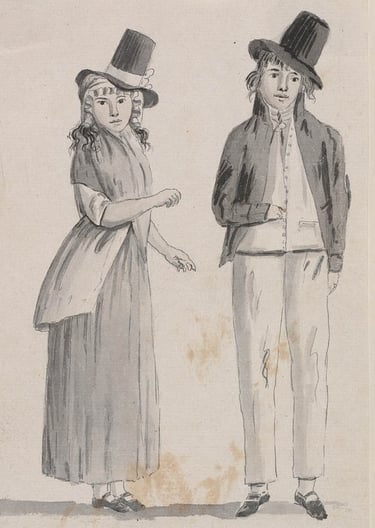
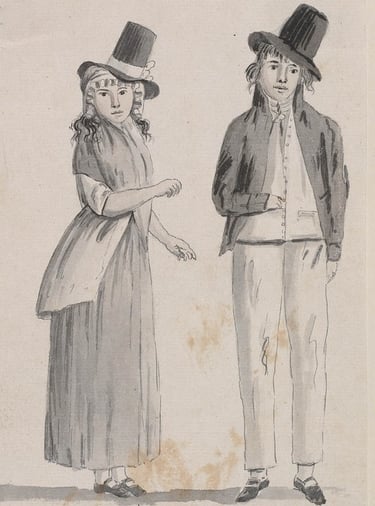
[1] Juan Ravenet, ‘Convictos en la Nueva Olanda [Convicts in New Holland]’, wash drawing. 19.5 x 12.5 cm, in Juan Ravenet & Felipe Bauza, ‘Drawings made on the Spanish Scientific Expedition to Australia and the Pacific in the ships Descubierta and Atrevida under the command of Alessandro Malaspina, 1789-94’, State Library of NSW, SAFE/DGD 2
[2] Ross to Nepean, 16 November 1788, UK National Archives, CO201/1/192a.
[3] Historical Records of New South Wales, 1:2, p. 213.
'Convicts in New Holland', 1793 [1]
Contact us
Botany Baymen acknowledges the traditional custodians of country throughout Australia and respects their connection to land, water and community.
© Botany Baymen 2024-2026. All rights reserved.
You may download, display, print and reproduce this content for your personal or non-commercial use but only in an unaltered form and with the copyright acknowledged.
Privacy Policy

Subscribe to our latest updates
Be the first in the know. We promise no spam.