
The Ships in the 'Watling' View
Close reading of an early sketch of Sydney Cove in the 1790s reveals the images of two more Botany Baymen.
Gary L. Sturgess
10/28/20254 min read
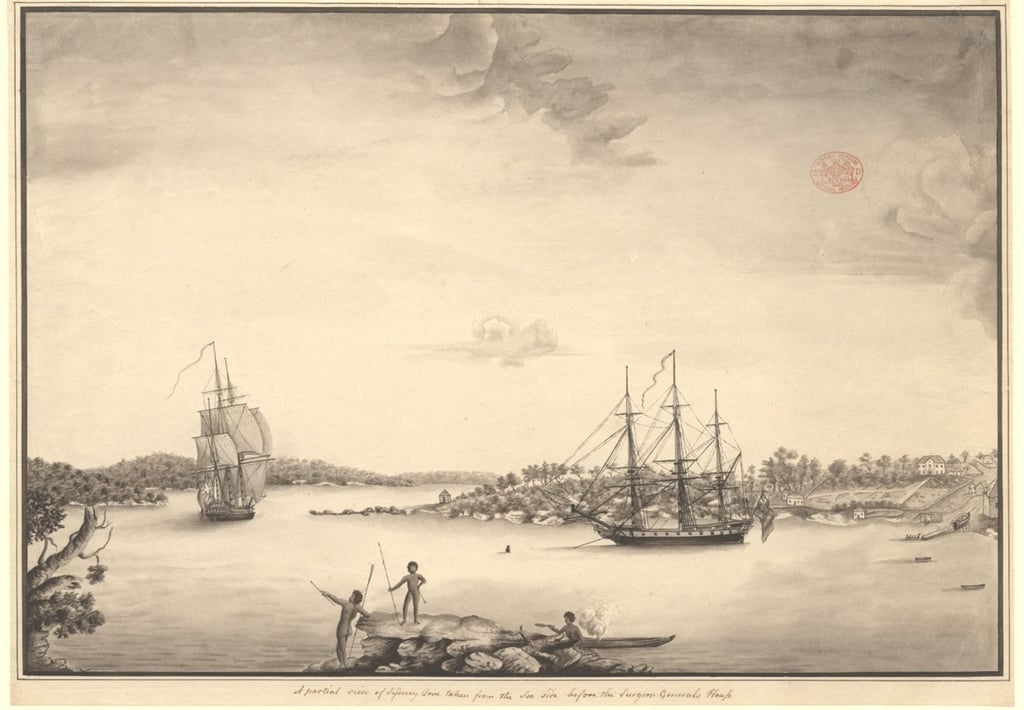
Fifteen years ago, M.G. Ellery, a contributor to an online forum of the UK’s Society for Nautical Research (SNR), published a note identifying the ships in an undated monochrome sketch of Sydney Cove, which shows a group of Aborigines fishing from a prominent rock in the cove, with two unidentified ships in the background.
Art historians had dated it to the period 1790 to 1795 and it had been given the title ‘A Partial View of Sydney Cove taken from the Seaside before the Surgeon General’s House’. The artist is unknown. In the past it has been attributed to Thomas Watling, but now it is attributed to the 'Port Jackson Painter', a title which refers to a number of unknown early artists. The original is found at the UK’s Natural History Museum.
Through close reading of the sketch itself and textual sources, Ellery concluded that the ship anchored in the cove was the Britannia, Raven, a storeship which was based out of the settlement from 1792 to 1796, and that the vessel making its way down the harbour was the Daedalus, a storeship under contract to the Royal Navy.
Given the identification of the Daedalus, Ellery argued that we could precisely identify the day on which the sketch was made – 1 July 1793.
No one has commented on Ellery’s paper, and my attempt to make contact through the SNR failed, but a more detailed analysis of the sources establishes that he was right. This Catspaw communicates our research to a wider audience.
The key to the identification of these ships lies in a detail at the far right of the sketch showing a small vessel in the stocks on the eastern side of the cove. Ellery concluded (correctly in my view) that this could only have been the Francis, a 41-ton sloop which had arrived on the Pitt, ‘in frame’, on the 14th of February 1792. We can establish an end-date for the sketch from the fact that the Francis was put in the water on the 24th of July 1793.
A detailed analysis of visual and textual sources enables us to be even more precise than Mr Ellery.
The Watling sketch shows a completed vessel ready to be launched, similar to a drawing by the Spanish artist, Fernando Brambila, who was in NSW with the Malaspina expedition between 12 March and 11 April 1793.
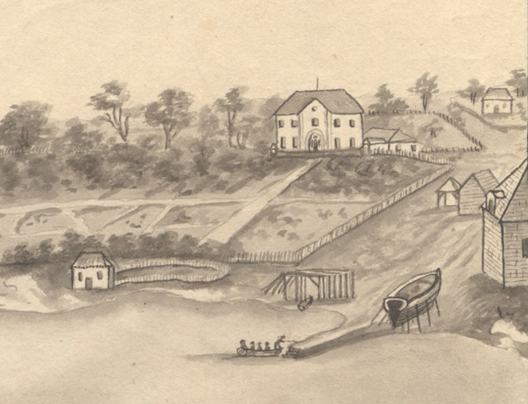
Port Jackson Painter, ‘A Partial View of Sydney Cove. . .’ (detail)
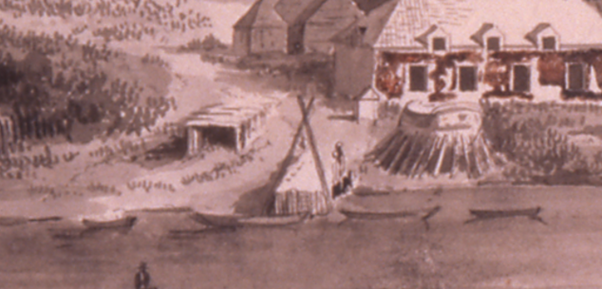
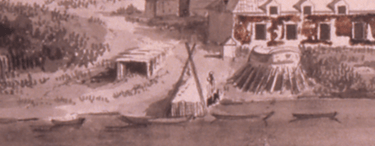
Fernando Brambila, ‘View of Sydney Cove from the North-West’ (detail), British Library, George III, Kings Topographical Collection, Maps K. Top.124 Supp.fol.43
I would submit that the Watling sketch cannot be earlier than February 1793. In this period, six ships visited the cove (three more than identified by Ellery):
The Chesterfield, Alt, a whaler which came in for repairs in November 1792 and did not finally sail from Port Jackson until 19 April 1793;
The Shah Hormuzear, Bampton, an Indian trader, which arrived on 25 February and sailed with the Chesterfield;
The two ships of the Spanish expedition, El Descuvierta, Malaspina, and L’Atrevida, Bustamente, which arrived on the 12th of March and sailed on the 20th of April;
The Daedalus, Hanson, a transport taken up by the Admiralty for service in the Pacific, which arrived in Port Jackson on the 10th of April and sailed again on the 1st of July; and
The Britannia, Raven, a storeship which returned from a voyage to the Cape of Good Hope on the 25th of June and sailed with the Francis on the 7th of September.
There are only three of these ships which could be the vessel making its way down the harbour while the Francis was still in the stocks – the Daedalus, the Chesterfield and the Shah Hormuzear, and we can eliminate the last two, since they left the cove together.
This means that this sketch must have been made on the 1st of July 1793, that the ship making its way down the harbour was the Daedalus and that the ship at anchor was the Britannia, the only other vessel present in the harbour that day.
Moreover, the ship drawn by the Port Jackson Painter is consistent with descriptions of the Britannia – three masted, with a poop deck, square-sterned with a quarter gallery and a figurehead (presumably of the goddess herself).
Port Jackson Painter, ‘A Partial View of Sydney Cove Taken from the Sea side before the Surgeon General’s House’, UK Natural History Museum, Watling Collection 14
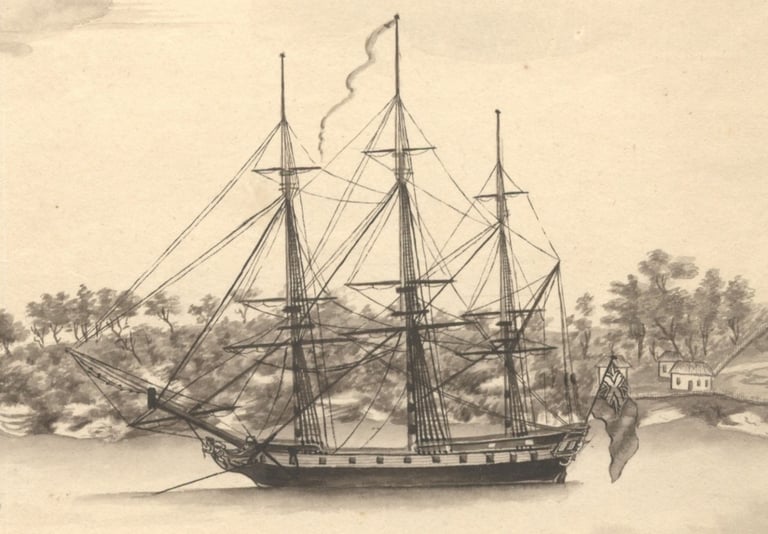
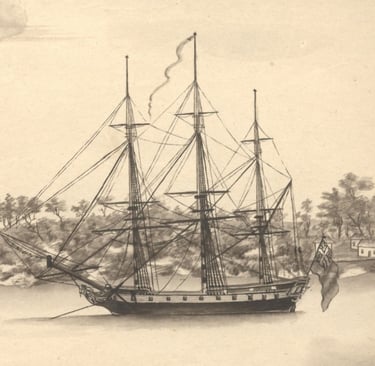
Port Jackson Painter, ‘A Partial View of Sydney Cove. . .’ (detail)
The date of this sketch is historically significant - the Britannia had returned several days before from the first commercial venture of the (soon-to-be notorious) NSW Rum Corps.
Contact us
Botany Baymen acknowledges the traditional custodians of country throughout Australia and respects their connection to land, water and community.
© Botany Baymen 2024-2026. All rights reserved.
You may download, display, print and reproduce this content for your personal or non-commercial use but only in an unaltered form and with the copyright acknowledged.
Privacy Policy

Subscribe to our latest updates
Be the first in the know. We promise no spam.