
The Half-Hanged Marines
Gary L. Sturgess
7/12/20266 min read
At around 9 o’clock on the morning of 27 March 1789, six private marines from Captain James Campbell’s company were marched across the parade ground of the European settlement at Sydney Cove, then only 14 months old, and hanged on a common scaffold which had been erected overnight.
For those, like me, who like to recreate historic spaces of the past in their imagination, that parade ground today forms the intersection of George and Grosvenor Streets in the City of Sydney. The gallows were located between two storehouses which lay a short distance to the northwest of this intersection, now buried beneath the Johnson’s Building (which houses Morrison’s Oyster Bar and Grill on the ground floor).
These men were executed for systematically stealing from the storehouses they had been assigned to protect, over a period of many months, and given that the marines had been sent halfway around the world to protect the colony against such depredations of the convicts, this was for the whole garrison, a shameful affair.
The humiliation was made worse by the burial of these men on the opposite side of the parade ground, which also served as a public square, directly across from the commanding officer’s house (which also served as the marines’ headquarters).
Unsurprisingly, these events had a deep impact on the small community of convicts, marines and civil officers living in the corridor which lay between the cove and ‘the woods’ (as the dense bush surrounding them was known).
Many of the marines, officers as well as enlisted men, wept at the hanging. Their commanding officers were furious that the civil authorities failed to prosecute some of the convict women who had profited from these crimes and given evidence against their fellow soldiers in court.
The convicts gloated over this surprising new manifestation of ‘the world turned upside down’. Six months after the hangings, a middle-class convict goaded a marine private in the high street, not far from the gravesite:
'You and your fellow soldiers are free men and all honest of course. You came to do duty over a parcel of whores and thieves – but who are the whores, thieves and convicts now?' [1]
It is some measure of how deeply this incident was carved into the collective memory of the community that two decades later, a nine-year-old boy living near this site believed that some of these men had been buried half alive and haunted their house. The house had been exorcised, but their troubled spirits had not been laid to rest. The house dog would station himself by the cellar door at night and howl frightfully, until he was himself put down. [2]
While some of the convicts had been aware of what was going on, the first that the authorities learned of this gang was nine days before the hanging when a broken key was discovered in one of the locks of the provisions storehouse on the west side of the camp.
It would have immediately been assumed that convicts were responsible, but the investigation quickly identified Private Joseph Hunt as the owner of the key. He was arrested and promptly confessed, naming six fellow marines and offering to give evidence against them in return for a pardon.
The investigation was conducted by the Judge Advocate, David Collins, and the Lieutenant Governor (and marine commander), Major Robert Ross. Ross was responsible for managing the marines and convicts on the west side of the stream which divided the settlement, but given that marines were involved, it made sense for him to be involved in preparing the case for the prosecution.
Some of the convict women who had socialised with these men also gave statements, supporting Hunt’s self-serving testimony (which would have otherwise been inadmissible).
The case was heard by the criminal court over the 25th and 26th of March, the bench being composed entirely of marine officers. This was necessary in part because HMS Sirius had not yet returned from a voyage to the Cape of Good Hope and only one other naval officer was available, but once again, it was politic to have the marine officers involved. Other than David Collins (who was also a captain of marines), the senior marine officer on the bench was James Campbell, who was the defendants’ commanding officer and was being given an opportunity to clean up his own mess.
In a unanimous verdict, the six men were found guilty. Collins wrote that, given the magnitude of the crime, there was no alternative to the death penalty. Their findings and the sentence would have been sent across to the Governor for his endorsement, and by the time this arrived back at the court, around 2.30 on the afternoon of the 26th, work had already begun on the gallows.
Reverend Richard Johnson visited the men in the guard house early the next morning, when one of the condemned men reported that similar practices had been going on at Rose Hill, a satellite settlement recently established some miles to the west (now known as Parramatta). David Collins came over and took his statement, but it was not thought necessary to delay the execution. As was conventional, they would have been given the opportunity to write letters home.
No account of the execution is known to have survived, but based on the practice at previous convict hangings, the condemned men, with their hands tied, would have marched across to the gallows guarded by a detachment of their fellow marines. This parade would have been led by the Provost Marshal, a civil officer, and his two constables (one of whom was a convict), the clergyman and the hangman (also a convict).
The six graves would have already been dug and would have been visible on their right as they marched across the parade ground.
On arrival, the death warrant would have been read, and Reverend Johnson would have prayed with them. They were then permitted to deliver some last words to the assembled crowd. It was conventional at this point for the condemned to confess their crimes and caution those present against following their path, but the only record we have of their last words, written by another marine private, says that they accused their accuser, Joseph Hunt, of having instigated the whole scheme.
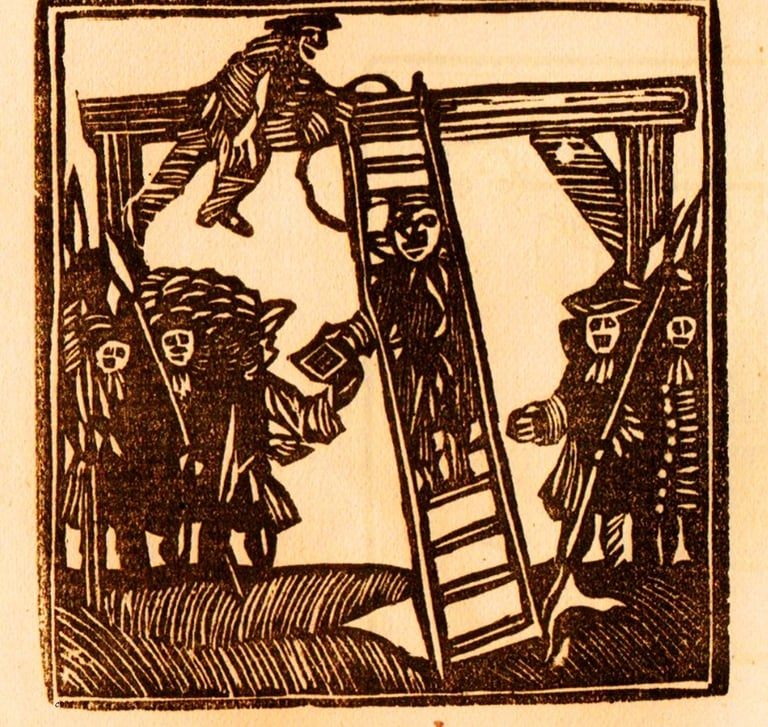
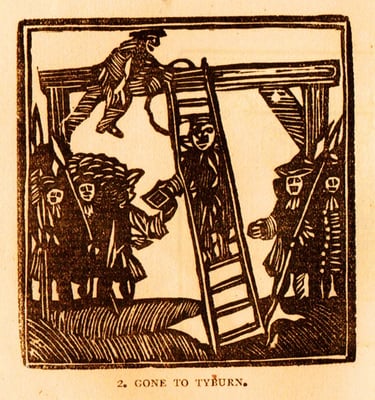
Previous hangings had used a large tree but given the number of men involved on this occasion, some kind of scaffold was necessary. This would have consisted of a long beam supported at either end, similar to the gallows used at Tyburn, from which the halters would have been suspended. Six ladders would have been propped against this beam, as in the illustration ‘Gone to Tyburn’ above.
Based on what we know of the earlier hangings, the men would have ascended these ladders, followed by the hangman, who would have slipped the noose around their necks and possibly tied a large handkerchief across their faces (to conceal the death throes). He would have climbed back down and on being given the order, would have turned the ladders over one by one, causing the men to fall and, hopefully, break their necks bringing instant death. (This is the origin of the term ‘turned off’).
Their bodies would have been left hanging there for around an hour, then taken down and carried across to the other side of the parade ground and buried. Later that day, Reverend Johnson entered their names in a separate section of the parish register reserved for suicides and executions, with a bracket against all six names and the word ‘Marines’ inscribed in the right-hand column.
A plan of the settlement dated to 1790 shows six crosses at the edge of the parade ground, close to the only crossroads in the colony. This was not an official burial ground, and the suggestion made by Sydney historian, Michael Flynn, that this was the initial resting place of the hanged marines, seems highly plausible. [3]
'Gone to Tyburn', Woodcut, 18th century
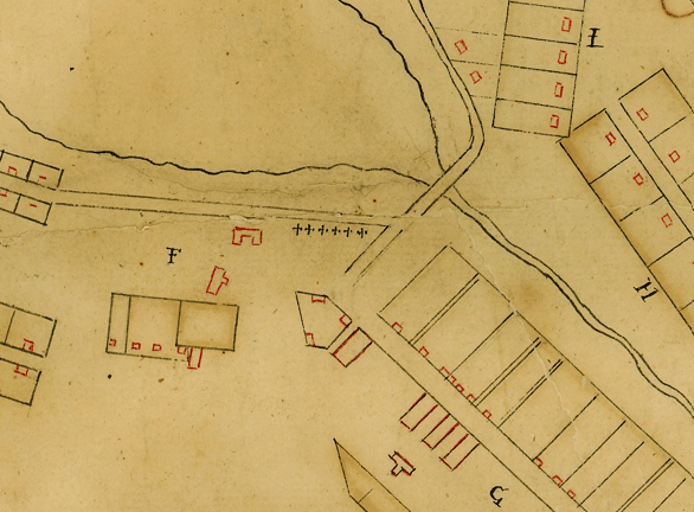
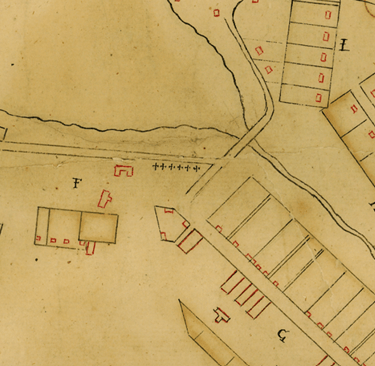
Detail of a plan of the settlement in 1790, showing six crosses at the junction of the high street and the bridge street. The storehouses are the buildings in red to the right of the letter ‘F’. [4]
It was customary, although by this time not common, for suicides and hanged criminals to be buried at a crossroads. The practice dates back to ancient times and continued in Britain until 1823 when highway burials were banned by Act of Parliament. The origins of the practice are not well understood, but gallows were often located at crossways, and it was convenient to inter the bodies nearby. Tyburn was at a crossroads on the outskirts of Greater London.
Folklore maintained that death and burial at such liminal places resulted in the souls of these men and women becoming lost – which helps to explain the ghost stories which built up over time about the haunting presence of six half-hanged men at the corner of George and Bridge Streets. [5]
_________________
I acknowledge the contribution of Michael Flynn in discussing this subject over the years – in seeing the crosses on the 1790 plan, and in identifying the author of the 1827 reminiscence about the restless souls of the ‘half-hanged’ marines.
[1] This is a first-person rendition of a statement sworn by the marine private, Arthur Dougherty, on 13 October 1789 – Transcript of the Court Martial of Captain John Meredith, 3 to 18 September 1792, UK National Archives, ADM1/5491.
[2] The Australian, 31 October 21827, p.3.
[3] Personal communication with the author, 2022.
[4] ‘A Survey of the Settlement in New South Wales, New Holland’, n.d. but based on the features, it was compiled over time from early 1790 to mid-1791, State Archives of NSW, SZ430.
[5] See, for example, Bill Angus, A History of Crossroads in Early Modern Culture, Edinburgh University Press, 2022, Chapter 5.
Contact us
Botany Baymen acknowledges the traditional custodians of country throughout Australia and respects their connection to land, water and community.
© Botany Baymen 2024-2026. All rights reserved.
You may download, display, print and reproduce this content for your personal or non-commercial use but only in an unaltered form and with the copyright acknowledged.
Privacy Policy

Subscribe to our latest updates
Be the first in the know. We promise no spam.