
The Fate of a First Fleet Convict
Gary L. Sturgess
5/2/20264 min read
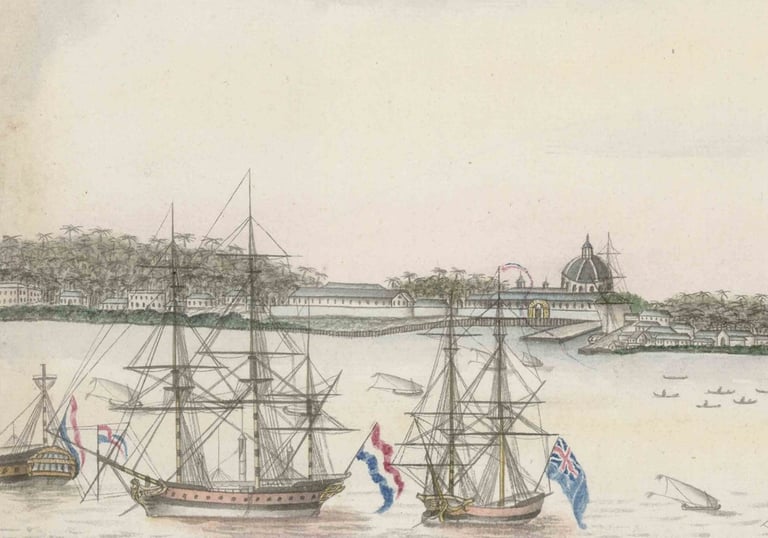
Historians of Australian convict transportation are blessed with a rich array of sources to track the journey of individual offenders through the criminal justice system, the passage to Australia and their later life in the colony, but there are many men and women who disappear from the records without a trace, and we have no idea what happened to them.
Until last night, this was the case with William Gloster (als Gloucester) and his wife, Charlotte Sprigmore (als Springmore), two First Fleet convicts. Mollie Gillen, in her encyclopaedic biographical dictionary, Founders of Australia, noted that they left Norfolk Island on the Britannia in November 1793 on her voyage to Bengal to purchase provisions for the settlement. And while Gillen was able to find Sprigmore and a child in later New South Wales records, she had been unable to determine what happened to Gloster.
The journal of Robert Murray, 3rd Mate of the Britannia, the original of which is held by the Peabody Essex Museum at Salem in America, provides us with an unusually rich account of what happened to them. [2]
Gloster sailed from Norfolk Island on the Britannia as the caulker, taking with him Charlotte and their two young daughters, Charlotte and Mary. There is little in Gloster’s biography to suggest that he had a maritime background, but on the voyage out to NSW in the Alexander in 1787, he had been assigned to a mess with five other men with skills that would have been useful in managing the ship, including two carpenters, a sawyer and a cooper. (Caulking involved packing old cloth and oiled hemp into the gaps between the planks on a wooden ship to provide a watertight seal.)
The Britannia touched at Batavia in February 1794 on her way north, where Captain Raven learned that Britain was at war with France and the waters between Batavia and Bengal were infested with French privateers. He obtained permission from the Governor and Council to purchase their provisions there.
Batavia was notorious for yellow fever, and it was not unusual for Europeans to come down with this disease and die while the ships were in port. A number of the Alexander’s crew had died there in November and December 1788 as she was returning home from NSW, and William Bryant, the organiser of Botany Bay’s most famous escape, passed away in the hospital at Batavia in December 1791, along with one of his young sons.
William Gloster was to be another victim of ‘the unwholesome air of Batavia’ (as James Cook had described it). Robert Murray provides a detailed description of what happened to him and his family:
". . . in the fifth week the Caulker was taken ill, he was followed by 3 more. The complaint of the Caulker was of a pressure heat and pain in the breast, with sickness in the Stomach and loss of appetite – sure prognosticks of the most fatal events – The others were at first sick – this was followed by an intermittent fever, and concluded in a Tertian and Quartian ague, after which they recovered. The caulker after laying a week died. . .
"These events which were followed by the Death of Mary, the daughter of W. Gloucester the caulker; the innocent prattle of this infant had endeared it to us all, its Mother with great impropriety had taken the child on shore, where from a want of care in the authoress of its existence, it caught the fever which killed it. The woman with an inhumanity which I now shudder at, had in their sickness pass’d not the least attention to Husband nor child; the former would, had not the sailors humanity assisted him, have wanted the common necessaries of life – The infant expired in the arms of an intoxicated Mother.
"The remaining child (for she had two) was taken by a Gentleman whose name I regret having forgot. He had attended the Man from motions of humanity in his ilness, and had remarked the want of Maternal affection in the mother, to save the remaining child he took her himself, ridding the unhappy women of what She thought an incumbrance.
"The scenes, the shocking effects of intemperance and want of care, had such an effect upon the Seamen that they would hardly be persuaded to go on shore, and when there, they were glad of an opportunity of returning to the ship."
This is probably unfair on Charlotte. Yellow fever is spread by mosquitos, and it is possible that young Mary caught the disease whilst she was on the ship. Charlotte must have been terrified about what was going to happen to her, potentially stranded in a foreign port with a young child and without support.
It is likely that Captain Raven took the two Charlottes, mother and daughter, back to NSW on the Britannia. Charlotte is next recorded in the 1801 census as living at Sydney and off the government stores, but later moved to the Hawkesbury, where she purchased a plot of land and ‘hoed in it many years’. She died there, around 66 years of age, in 1822, having fallen in a waterhole and drowned. Her daughter had predeceased her by several years.
_________________________
[1] George Raper, ‘View of the City of Batavia from the Anchorage in the Roades. . .’, Natural History Museum, London, Rare Books Room 163.
[2] Robert Murray, ‘Journal of a Voyage from England to Port Jackson, New South Wales, in the Years 1792, 1793, 1795 and 1795, in the Ship Britannia, Mr W. Raven Comm’r’, Peabody Essex Museum, Journal 26.
Detail of George Raper, 'View of the City of Batavia. . .' 1791 [1]
Contact us
Connect with us
Botany Baymen acknowledges the traditional custodians of country throughout Australia and respects their connection to land, water and community.
© Botany Baymen 2024. All rights reserved.
You may download, display, print and reproduce this content for your personal or non-commercial use but only in an unaltered form and with the copyright acknowledged.