
Solomon Polock: Convict, Escapee, Mercenary
Gary L. Sturgess
6/24/20264 min read
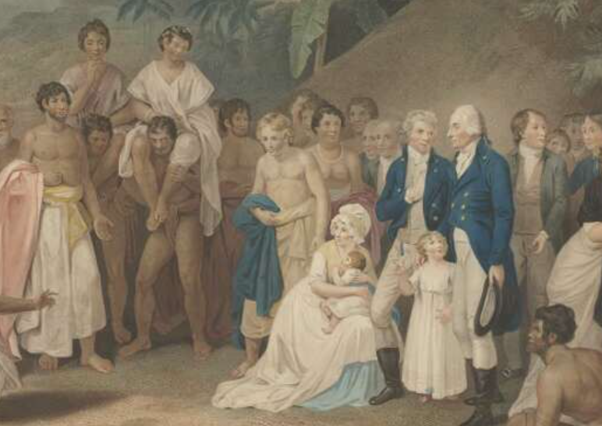

When Solomon Polock, an Ashkenazi Jew of Polish descent, returned to London in July 1798, browned by the Pacific sun and tattooed from head to toe, what stories he had to tell.
At the age of 23, Polock had been sent to NSW with the Second Fleet for stealing 60 yards of cotton from a warehouse in the heart of London. Facing a life sentence, he decided not to stay, and escaped on the Matilda, one of the Third Fleet whalers, which sailed from Port Jackson in December 1791 for the west coast of South America. Whaling crews were paid a percentage of profits rather than a wage, and it is unlikely that he would have been taken on board if he did not have some maritime experience.
They were never to reach the fishing grounds of the South Pacific: on the 25th of February, days after sailing from Tahiti, the Matilda was wrecked on Mururoa Atoll. When it was clear that the ship could not be repaired, they made their way back to Tahiti in the whaling boats, taking their firearms (and their knowledge of how to use firearms) into a war that was building between the peoples of Oparre and Matavai on the northern side of the island.
Crew members found themselves caught up on opposite sides of this conflict, and while he is not mentioned by name in the accounts of this early period, there is no question that Polock fought with Captain Weatherhead and the majority of the crew alongside the Pomarre family of Oparre, who would eventually become the ruling family of Tahiti.
In late March 1792, Weatherhead and several of the crew left on a small schooner which had touched at the island on her way to the north-west coast of America for furs. They had no idea when another European ship might touch at the island, and Weatherhead was going for help.
By chance, a week after they sailed, William Bligh arrived on his second breadfruit voyage: the Providence and the Assistant took away 15 more of the crew, but several men, including Polock, remained to take their chances among the islanders.
We don’t know whether he made a conscious choice to become a beachcomber, but had he returned to England, Polock would have faced the death penalty for escape. One of Bligh’s officers wrote in his journal:
'Several men late of the Matilda, now embarked for a passage home, but four or five remained by choice on the island, one of whom was a Jew convict that had come in her from Sydney. To those who remained Captain Bligh, with great consideration, addressed a letter exhorting them to peace and good conduct, but if unfortunately, after the departure of the Providence hostilities should take place, to give their assistance to the royal party. . .' [2]
Bligh’s journal makes it clear that he knew Polock was an escapee who had been transported for life. [3]
As the wars continued, Polock continued to fight for ‘the royal party’, alongside two Scandinavians, Andrew Lind, a former shipmate from the Matilda, and Peter Haggerstein, who had absconded from another British vessel, the Daedalus. Polock was both fearless and a good marksman and made a significant contribution in the battles which raged throughout 1793.
It is likely that he took a wife (possibly several) from among the island women, as a number of the other European mercenaries did. When the Daedalus visited, the European mercenaries were being well-treated, with lands and servants. According to an account brought by the men of that ship, they had been ‘adopted. . . into the order of nobility, and as a proof of the insignia of their elevation, tattowed. . . from top to bottom’. [4]
The Providence returned in February 1797, under the command of Captain William Broughton, and Polock took the opportunity to leave. He is described in the ship’s muster book as a ‘distressed seaman’, 30 years of age from London, and he was taken on as an able-bodied seaman, further evidence that he had maritime experience. He left the ship four months later at Macau and joined the Glatton, an East Indiaman returning to London with a cargo of tea. [5]
This is the last glimpse we have of him, but it is likely that he returned to England in July 1798 when the Glatton arrived in the Thames, and disappeared into the Jewish community of London, where life would have been very different to what he had known a mercenary fighting on the black sands of Tahiti.
____________________________
[1] Detail from Robert Smirke, ‘The Cession of the District of Matavai. . . to Captain James Wilson’, 1798-1799, National Maritime Museum, Greenwich, ZBA6683.
[2] Roy Schreiber (e.), Captain Bligh’s Second Chance: An Eyewitness Account of his Return to the South Seas by Lt. George Tobin, London: Chatham Publishing, 2007, p. 117.
[3] William Bligh, ‘Log of the Proceedings of His Majesty’s Ship Providence on a Second Voyage to the South Seas to Carry the Breadfruit Plant from the Society Islands to the West Indies’, 18 July 1792, UK National Archives (hereafter TNA) ADM55/152, p. 178.
[4] Ipswich Journal, 12 March 1796.
[5] ‘Muster Book of the HMS Providence’, William Broughton, TNA ADM36/13498; William Robert Broughton, A Voyage of Discovery to the North Pacific Ocean, London: Cadell & Davies, 1804, p. xv.
Polock’s fellow mercenary, Peter Hagerstein (holding the blue cloak), acting as translator between missionaries and the Tahitian chiefs [1]
Contact us
Connect with us
Botany Baymen acknowledges the traditional custodians of country throughout Australia and respects their connection to land, water and community.
© Botany Baymen 2024. All rights reserved.
You may download, display, print and reproduce this content for your personal or non-commercial use but only in an unaltered form and with the copyright acknowledged.