
Petitioning the King
In deciding whether to forgive a death sentence, George III relied heavily on the judges' advice. This Catspaw examines a case in 1798 where the King exercised the royal prerogative in his own right.
Gary L. Sturgess
1/11/20269 min read
The Royal Prerogative of Mercy
In the late 18th century, Britain’s criminal justice system relied heavily on the Royal Prerogative of Mercy to soften the harsh effects of legislation and take account of individual circumstances.
Judicial discretion had been significantly narrowed through the enactment of laws which made capital punishment mandatory for a wide range of offences, the result of politicians demonstrating that they were tough on crime. And while prosecutors, judges and juries found ways of interpreting the evidence so as to keep defendants outside the conditions specified for a capital offence, this was not always possible.
In some cases, the circuit judges would grant a reprieve even before they had left town, but offenders (and their relatives, and in some cases, the victim, the prosecutor and/or the jury) knew that if they petitioned the Home Secretary, they had a good chance of having their death sentence commuted to transportation or imprisonment in the hulks, and in some cases, a free pardon.
The descendants of Australian convicts often overlook this part of the criminal justice system in the late 18th and early 19th centuries. At the time, it was widely understood that only the worst offenders would be executed, particularly once transportation had recommenced in 1787.
Some convicts were forgiven because transportation was considered too harsh a penalty, because they were suffering from mental illness or too old or too sick to survive such an arduous voyage, because they had already served the majority of their sentence and had behaved well in prison. Leniency was also applied where there were perceived flaws in the evidence, where a female offender might possibly have been pressured by her husband and where individuals were seen to have been driven to offend through extreme poverty.
By 1786, the post-trial review of convictions and sentences had long been systematised – the sentencing judge would routinely be consulted, and a council consisting of the King, the Cabinet, and Archbishop of Canterbury, the Chief Justice of King’s Bench and several other judicial officers, would review each case in turn before arriving at a decision.
The Prerogative of Mercy was no longer in the King’s personal discretion (unlike the situation with the US Presidency today), but George III did regard the exercise of clemency as a personal responsibility. A print published in 1793 shows the King liberating an old man imprisoned for debt by personally paying what was owed: this was royal propaganda, but it was also a public manifestation of a quality expected of an ideal monarch.
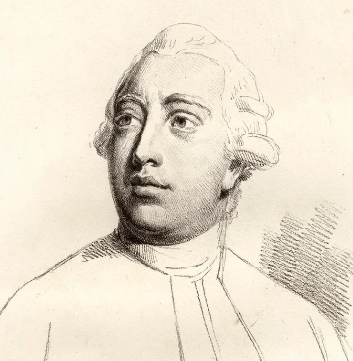

William Daniell (after Nathaniel Dance),’ King George III’ (detail), UK National Portrait Gallery
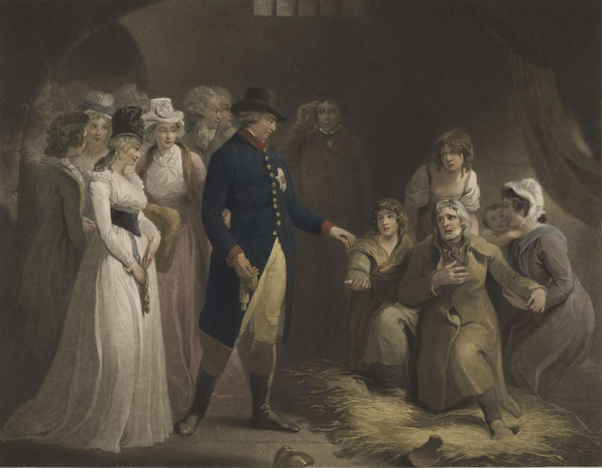
Charles Howard Hodges (after Thomas Stothard), ‘Royal Beneficence’ (George III visits Dorchester Prison), 1793
The great mid-20th century legal historian, Leon Radzinowicz, concluded that:
". . . George III paid great personal attention to many cases brought before him, often desiring to acquaint himself with all the circumstances which could bear upon his decision." [1]
In general, however, the King followed the judges’ recommendations. In 1767, the Earl of Shelburne, then one of the Secretaries of State, wrote to a member of parliament:
"Since his Lordship has been in office, it has been His Majesty's invariable rule to pay the greatest regard to the opinion of the Judges, not having, to his Lordship's knowledge, differed in any one case from it." [2]
The Case of Abraham Clark
But there were exceptions. This paper is concerned with one of those cases where the King did not follow the judge’s advice, where an offender, sentenced to be hanged on Kennington Common, was reprieved at the last minute through the personal intervention of the King himself.
Abraham Clark was convicted at Kingston-upon-Thames on the 22nd of March 1798 for stealing a large quantity of beaver skins and beaver wool, valued at £105, from a warehouse in the Borough (across from London on the south bank of the Thames).
This was a very large sum of money (roughly £20,000 today) and might well have warranted the death penalty by itself. But Clark’s late father had worked for some years for the owners of the warehouse, Fell & Steel, and it seems that he had taken advantage of his familiarity with the premises to carry out this audacious crime. The courts treated crimes involving a breach of trust much more seriously.
However, Clark had stolen from Fell & Steel several times before, and over the previous five or six years, he had been investigated in relation to a number of other offences. In 1796, he had been part of a gang which broke into a house at Lambeth belonging to the King’s bargemaster and killed his elderly wife.
Clark was found guilty of the theft and sentenced to death. The Southbank grocer to whom he sold the furs, Richard Redmayne, was also convicted of receiving, and sentenced to transportation for 14 years, the usual punishment for that crime. Clark was due to be executed the following month.
His mother, a widow still with two dependent children, was devastated, unable to eat, and according to friends and associates, was not able to do so for several weeks. Based on the evidence we have of how other parents reacted to the news that their children were to be executed or sent to Botany Bay, there is no reason to disbelieve these accounts.
A chapbook published at the time stated:
"This unfortunate young man came of honest and reputable parents, whose tender and anxious care of his earlier years, gave the greatest reason to hope and expect he would have gone through life with credit to himself, and comfort to his fond parents." [3]
When young Abraham was 14 years of age, his parents had offered to find employment for him in a number of fields, but he was insistent that he wanted to become a waterman. An apprenticeship was arranged, but after several years, he fell into bad company and started associating with a gang of serious criminals.
Mrs Clark spoke with John Fell, her late husband’s former employer and one of her son’s victims. Fell and his partner were Quakers, and while they thought that young Clark deserved to be punished for his crimes, they were horrified that a sentence of death had been handed down. He supported Mary’s petition, which begged that Abraham’s sentence be commuted to transportation so that he might ‘live a useful Member of Society’. She was also supported by the chaplain of St Saviour’s at Southwark, who said that she was ‘a very excellent Woman and worthy of every favourable attention’.
This was just the start. Mary spoke to a gentleman from the Borough who knew the local MP, Henry Thornton, a leading Evangelical and Abolitionist, who wrote to the Home Secretary. Not being familiar with the details of the case, Thornton simply suggested that in the absence of aggravation, a death sentence seemed a very severe penalty.
She also spoke to her brother-in-law, Isaac Clark, who was (fortuitously) the King’s butler at Windsor Castle. As a senior member of the King’s household, Isaac had access to the highest levels of English society: he contacted the Marchioness of Bath, and begged her to speak with her brother, the Duke of Portland, who was the Home Secretary. She was also cautious, but asked that any favourable circumstances be considered:
". . .the poor man was so wretched for his Nephew I could not refuse just mentioning it to you – tho’ I told him he would have the same attention without my troubling you. . ." [4]
The Home Secretary immediately passed these documents on to the judge, Francis Buller, who responded the following day, advising that Clark had been convicted on the clearest of evidence, and that he had confessed to robbing the prosecutors several times before. The crime had been committed by five men, of whom Clark appeared to be the ringleader. No one had appeared at court to give character evidence on his behalf, and Buller did not think that he was deserving of mercy.
"The Prosecutors are Quakers & on that Account were reluctant that any Man should be hanged on their Prosecution: which I told them was a very ill forwarded Notion & I should pay no regard to it." [5]
If the Home Secretary wanted to know more about this man’s character, he should inquire of the John Townsend (one of the leading thief takers in the Bow Street Runners), ‘for the Man is well known’.
William Wickham, then permanent secretary at the Home Office, immediately wrote to Henry Thornton (and no doubt to Mrs Clark), advising that his response was ‘extremely unfavourable’.
At some point in the next few days, Fell and Steel petitioned the King direct, asking that Clark be transported for life, or given some other penalty where he prevented from causing further damage to the community. This was also sent to the Home Office, where (once again) it fell on deaf ears.
Isaac Clark now asked John Rippon, the Baptist minister at Southwark, whether something more could not be done. Rippon spoke with the Southwark magistrates and with William Wilberforce, and they offered the following advice.
Clark should himself draw up a petition and present it to the King in person. He should acknowledge that his nephew was guilty of the crime in question, but point out that he had never been tried, let alone found guilty of prior offences. One of the Southwark magistrates wrote to the clerk of the arraigns for Surrey, and obtained a certificate to the effect that, while young Clark had once been taken up on suspicion of crime, no prosecution had followed.
This was an interesting strategy, since it suggests that the justices of the peace were themselves uncomfortable with the practice, then common in the criminal courts of England and Wales, where judges and magistrates took into account prior unsuccessful prosecutions and police intelligence when handing down their sentences.
Rippon’s advice continued:
"Tell the King that he is your relative, & that you shall be infinitely obliged to his Majesty to have him transported – that thus all ye ends of Justice will be answered. That all our Justices of ye peace wish it, & so do our Members of Parliament & ye Prosecutor". [6]
This letter was sent by messenger to Isaac Clark at Windsor on the 9th of April, with a warning that he was not to wait a moment in making his approach to the King. (The execution was to take place four days later.)
There is no documentary record, but it is evident that Clark did speak to the King, and that the King was moved by his plea and issued a directive to the Home Secretary. On the 12th of April, the day before the hanging, the Duke of Portland wrote to the King, advising that he would immediately send a respite, and direct a conditional pardon be prepared for his signature. It is evident that he was not impressed:
". . . the applications which have been made on behalf of this unhappy Convict have occasioned the Duke of Portland to make repeated inquiries respecting him, the result of all which the Duke of Portland is sorry to observe to Your Majesty had been equally unfavourable. . ."
As Secretary of State, he was obliged to follow the King's directions, and he added: "whatever his character may be as an Accessory in the burglary only, Your Majesty will condescend to consider him not unworthy of mercy. . .' [7] It was such a narrow escape that several newspapers reported that Clark had been executed.
According to contemporary accounts, John Fell later went to Windsor to personally thank the King for this exercise of mercy, but whether he was granted an audience is unknown.
Analysis
The Clarks were not well-to-do nor particularly well-connected. Abraham’s father had been a trusted employee of Fell & Steel in the Borough for 17 years. His mother was a devout woman, respected in her local community. The family’s response was to rely on a network of contacts within that community – their minister, the local MP, one of the local magistrates, and the prosecutors themselves.
These petitions failed because of the seriousness of the crime, information which suggested that young Clark had been an active member of a criminal gang for several years, and the fact that he was now seemingly a gang leader. Most other young men in his situation would have gone to the gallows.
Their trump card was a family member who had served the King at Windsor Castle for a number of years and had risen to become his butler. The fact that under George III, the royal household was relatively informal worked to their advantage. This conduit, and a petition informed by sage advice from individuals involved in the criminal justice system at Southwark who knew how the pardoning process worked, secured the exercise of the royal prerogative against the advice of the judge and the Secretary of State.
After-story
Six weeks after hearing that his death sentence had been commuted to transportation for life, Clark was discharged from the New Gaol in the Borough to the Fortunee hulk at Langstone Harbour (near Portsmouth), along with 15 other men, including Richard Redmayne. They were sent on board the Hillsborough in late November, which was to carry them to NSW.
Because of his social status and his experience as a grocer, Redmayne was appointed as the convict steward on board the ship, responsible for issuing their provisions, and he selected Clark as his assistant.
The Hillsborough had a dreadful passage, with almost a third of the convicts dying of typhus before they arrived in Sydney Cove. Redmayne passed away a month after sailing, and Clark took over his responsibilities.
In the end, transportation proved to be a death sentence for Abraham Clark. He died a week after the ship made its way into the cove and was buried on shore on the 6th of August 1799.
_____________________
[1] Leon Radzinowicz, A History of English Criminal Law and its Administration from 1750, Volume 1, London: Stevens and Sons Limited, 1948, p.121.
[2] Earl of Shelburne to Humphry Morice, 30 September 1767, in Joseph Redington (ed.), Calendar of Home Office Papers of the Reign of George III, 1766-1769, Vol.1, London: Longman & Co, 1879, pp.187-188.
[3] ‘The Last Dying Speech and Confession, Life, Character and Behaviour of the Four Unfortunate Malefactors Executed this Day upon Kennington Common’, n.d. but July 1798.
[4] Marchioness of Bath to the Duke of Portland, 26 March 1798, UK National Archives (hereafter TNA), HO47/22/23-24.
[5] Francis Buller to the Home Secretary, 28 March 1798, TNA HO47/22/12-13.
[6] John Rippon to Isaac Butler, 9 April 1798, TNA HO47/22/10-11.
[7] Duke of Portland to the King, 12 April 1798, Royal Collections Trust, George III Calendar, GEO/MAIN/8826.
Contact us
Botany Baymen acknowledges the traditional custodians of country throughout Australia and respects their connection to land, water and community.
© Botany Baymen 2024-2026. All rights reserved.
You may download, display, print and reproduce this content for your personal or non-commercial use but only in an unaltered form and with the copyright acknowledged.
Privacy Policy

Subscribe to our latest updates
Be the first in the know. We promise no spam.