
Patrolling the Lines of Limitation
Gary L. Sturgess
5/31/20266 min read
In the early years of European settlement, the small village established on the shores of Sydney Cove was hemmed in by the bush and marines patrolled the ‘lines of limitation’ at the edge of the camp.
Early Days Ashore
One of the marines’ first tasks on going ashore in Sydney Cove on the morning of 26 January 1788, was to mark out the boundaries of the camp. According to one of the early officers:
'The moment Commodore Phillip had made good the landing of the marines, and some lines of limitation were marked out, the convicts were put on shore; and the artizans among them, with those belonging to the ships, proceeded to cut down wood to form their habitation. . .' [2]
Given the time available, it is likely that these ‘lines’ were nothing more than blazes cut into tree trunks, perhaps painted with whitewash. The surgeon, John White, later noted that when they when they went for walks in ‘the woods’ (as they called it), they took a small hatchet, ‘to mark the trees as we went on, those (called in America Blazing) being the only guide to direct us in our return. [3]
From the outset, the lines of settlement were patrolled by the marines. A fragment of Captain James Campbell’s ‘orderly book’ has survived with an order for the 30th of January reading:
'The Patroles to bring in All Straglers, & to fire On Any that Attempt to Escape or Any Convicts that Are Seen Out of Camp in the Night. . .
'A Serjt [serjeant] to be Added to the Quarter Guard for the purpose of Inforcing the Genl. Orders. With Respect to Straglers.' [4]
A ‘straggler’ was a convict who wandered out into the woods on their own, without permission, to avoid work, escape punishment or forage for greens.
The primary responsibility for keeping the convicts within bounds lay with the provost martial, a civil officer appointed by the Governor on the second day ashore, and his constables. John White noted that the convicts had been ordered to remain within the marked ‘outlines’ of the camp, and the provost marshal and the patrol were given orders to take into custody any found outside the lines and to hand them over to the main (marine) guard. In the days immediately after going ashore, the civil law officers and ‘a party of ye Soldiers’ were jointly responsible for preventing the convicts from ‘straggling into the Woods’.[5]
The marines continued to patrol ‘the lines of the encampment’, but it appears that in the weeks after landing, they announced that they would do nothing to prevent the convicts from wandering out into the bush and not even collect their names for use by the civil authorities.
In describing the lines of settlement in those early weeks ashore, marine captain-lieutenant Watkin Tench acknowledged that the stragglers were deserters from public labour, and that there was the potential for ‘ill consequences’ for the settlement if they ran into local Aboriginal groups and conflict resulted. Tench writes that ‘every care was taken to prevent it’, but he says nothing about the marine patrols playing any part in doing so: ‘The Provost Martial with his men was ordered to patrole the country around. . .’ [6]
In one of his first letters to the home government, Governor Arthur Phillip complained that most of the marine officers had refused to supervise the convicts: they insisted that they had not been sent out to do anything more than the duty of soldiers. They had even refused to identify convicts they had seen straggling in the woods. [7] Since they were manning a patrol along the lines of limitation, they were uniquely positioned to assist in that regard but declined to do so.
The convicts found it impossible to survive in the bush, and those who lasted out there for weeks or months did so by hanging around the edges of the camp and raiding huts for food. There were a significant number of convict workers whose day job required them to venture out into the woods: sawyers, shinglers and rushcutters usually worked in gangs, but the officers’ game-killers worked alone or in pairs, and they were all at risk of being attacked by warriors from the local Aboriginal clans.
There were also a number of buildings located outside this formal boundary – the brickfields (close to the modern-day site of Central Station), where a small community had been settled to make bricks; the Governor’s Farm (in what is now Farm Cove); and the farms of the officers and gentlemen (one on the current site of Sydney Town Hall, and the others over on Pyrmont and Balmain peninsulas).
But convicts also wandered out into the woods to collect greens (essential in fighting off scurvy) and sweet tea, a local plant which made a sarsaparilla-like drink which was drunk as a substitute for tea. They went into the woods to fight and have sex, to hide stolen goods, and to hide themselves when they were hoping to escape on a ship about to sail from the harbour or facing the prospect of punishment.
In short, there was a great deal of movement back and forwards across the lines of limitation, approved and non-approved, which was either not seen or not reported by the marine patrols.
The Aboriginal Incursion of June 1788
Late on the night of the 27th of June, a group of 20 to 30 Aboriginal warriors landed on the east point of the cove (today known as Bennelong Point) and made their way through the bush at the rear of Government House, which was still in the early stages of construction. They ‘proceeded along close by the centinels’, through the bush on the other side of the lines of settlement. The patrol only became aware of these men, who were standing metres away just inside the woods, when they heard them talking ‘with the greatest earnestness and vociferation’.
The patrol alerted the officer of the guard, ‘who immediately took every precaution to prevent an attack’ – presumably by increasing the number of men on that side of the camp. ‘At the same time [he] gave orders that no molestation, while they continued peaceable, should be offered them’.
When the bells on the ships out in the cove struck the hour, and the sentry called out ‘All’s Well’, the visitors went silent and then disappeared as quietly as they had come.
The marines were spooked by this incursion. Captain Watkin Tench used this incident to illustrate his concern that no ‘fortified post or place of security’ had yet been begun. Major Ross lobbied the Governor to build such a fort, which Phillip steadfastly refused to do, taking the view (correctly) that the Sydney clans would never attempt an attack on the camp itself. [8]
It was probably at this time that guns were placed at several points along the boundary. A source on one of the ships which left Sydney Cove two weeks after this incident reported:
'The natives, when they discovered the preparations on foot, and that their visitors were likely to become stationary, appeared so dissatisfied, that several pieces of ordnance were mounted on the lines to awe them. . .' [9]
As Stephen Gapps has demonstrated, tensions outside the lines intensified until the outbreak of smallpox in April 1789, with game-killers, rushcutters and convict stragglers being attacked and sometimes killed. [10] And by the time the local clans recovered from that terrible shock, relations between the two sides had thawed, the ‘camp’ was no longer an enclave set in the middle of a hostile wood, and movement back and forwards across the boundary was not unusual.
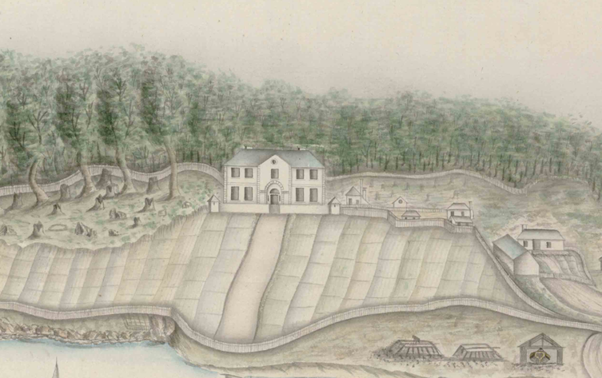
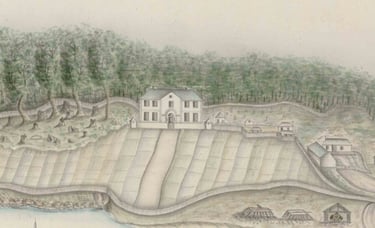
The painting at the head of this Catspaw was probably made in late February or early March 1791, when Midshipman George Raper was briefly in town on his way back to England. It is clear that the woods still came in close behind Government House. In that quarter of that the camp at least, the lines of limitation had not shifted since 1788, but at some point a fence had been constructed part of the way along the lines to the west of the Governor's House. Significantly, the fence does not continue all of the way to the gully which divided the camp (later known as the Tank Stream) at the western or right-hand side of this illustration. Something had happened which made that the completion of that physical barrier unnecessary.
______________________________________
Thanks to Michael Flynn for vigorous debates over several years on this question of the 'lines of limitation'.
[1] George Raper, ‘View of the East Side of Sidney Cove’, n.d. but prob. February-March 1791, UK Natural History Museum, Rare Books Room, 160.
[2] Morning Chronicle & London Advertiser, 27 March 1789
[3] John White, Journal of a Voyage to New South Wales, London: Debrett, 1790, p. 147.
[4] Captain James Campbell Orderly Book, 20 January to 3 February 1788, State Library of NSW, DLMS 33.
[5] George Worgan, Journal of a First Fleet Surgeon, Sydney: Library of Australian History, 1978, pp. 23 & 33; John White, Journal of a Voyage to New South Wales, op. cit., p. 121.
[6] Watkin Tench, A Narrative of the Expedition to Botany Bay, 2nd ed., London: Debrett, 1789, pp. 61-62.
[7] Arthur Phillip to Lord Sydney, 16 May 1788, Historical Records of New South Wales, 1:2, pp. 138-139.
[8] David Collins, An Account of the Colony in New South Wales, London: Cadell & Davies, 1798, p. 34; Watkin Tench, Narrative of the Expedition, op. cit., pp. 136-137.
[9] London Chronicle, 24-26 March 1789.
[10] Stephen Gapps, The Sydney Wars, Sydney: University of New South Wales, 2018.
Detail of George Raper, 'View of the Easy Side of Sidney Cove', showing the Governor's House in early 1791, with the woods close behind and a fence along the 'lines of limitation'. [1]
Contact us
Botany Baymen acknowledges the traditional custodians of country throughout Australia and respects their connection to land, water and community.
© Botany Baymen 2024-2026. All rights reserved.
You may download, display, print and reproduce this content for your personal or non-commercial use but only in an unaltered form and with the copyright acknowledged.
Privacy Policy

Subscribe to our latest updates
Be the first in the know. We promise no spam.