
Missing Manuscripts: John Marshall's Memoir
This newsletter reconstructs a memoir written by John Marshall, master of the 'Scarborough' a convict transport with the First and Second Fleets, which remains in the possession of his descendants.
Gary L. Sturgess
5/9/202614 min read
Several dozen letters and journals written by those who sailed with Australia’s First Fleet have survived – preserved because the authors of these documents, and their family and friends at home, understood at the time that this venture was historic.
But many First Fleet manuscripts are known to be missing. The recent discovery of a fragment of the personal journal of Arthur Phillip, commodore of the fleet and Governor of the new settlement, gives us reason to believe that important manuscripts still exist in private collections.
This newsletter deals with a memoir written by John Marshall – master of the Scarborough, a convict transport with the First and Second Fleets – which remains in the hands of his descendants.
Honest John Marshall
Captain John Marshall has long been regarded with affection by historians of convict history because of his involvement in both the First and Second Fleets. Daniel Southwell, a midshipman on HMS Sirius, referred to him as ‘honest Marshall’, and Elizabeth Macarthur, the wife of NSW Corps Lieutenant John Macarhur, who sailed with him on the Scarborough in 1790, described him as a ‘plain, honest man’, who made things as comfortable for them as he could.
'He. . . frequently amuses us with accounts of [New South Wales], and in what state he left it, and upon the whole they are flattering. He is a very humane man, and I am under the greatest obligation to him for his more than common attention to me and Edward [her infant son]. He accommodates us with everything in his power of which he thinks we stand in need, preventing my very wishes. He has left a wife and three children in England, of whom he speaks in the tenderest terms.' [1]
Governor Phillip’s official secretary, David Collins, also spoke of ‘Captain Marshall’s humanity’, in referring to his benign response to a conspiracy on the Scarborough on the Second Fleet. [2]
Others remember him because of Hector, the Newfoundland dog he left in the colony when he sailed for China in April 1788. Collins recalled that on Marshall’s return of the Scarborough in June 1790:
'. . . Hector swam off to the ship, and getting on board, recognised him, and manifested, in every manner suitable to his nature, his Joy at seeing him; nor could the animal be persuaded to quit him again, accompanying him always when he went on shore, and returning with him on board. . .' [3]
Other than this, almost nothing has been known of Marshall. For some years now, historians have been aware of a memoir, written by Marshall in his later years, copies of which are held by the family in Britain. To date, they have declined to place the manuscript itself, or its contents, in the public domain. They would be of great value to maritime historians in the UK and Australia.
However, snippets have emerged in a variety of different ways, and it is possible to partially reconstruct the memoir and learn something more about Marshall’s life.
The Marshall Memoir
The manuscript, apparently written in 1817 when he was 69 years of age, is entitled ‘A Journal of the different voyages of Mr John Marshall written by himself’. This seems to have been copied by Ann Bedford, whose name appears on the flyleaf – she was married to Marshall’s grandson, Henry Marshall Gisby, in 1841.
According to an inscription in the back of the journal, it was at one time accompanied by an old watch and the following text:
"On the 4th February 1797 10.00 o’clock A.M.: Capt. John Marshall on board “The Diana” of 14 guns & 24 men, had a ball pass through his body & another through his watch & thigh in beating off a French Privateer of 16 guns & 92 men."
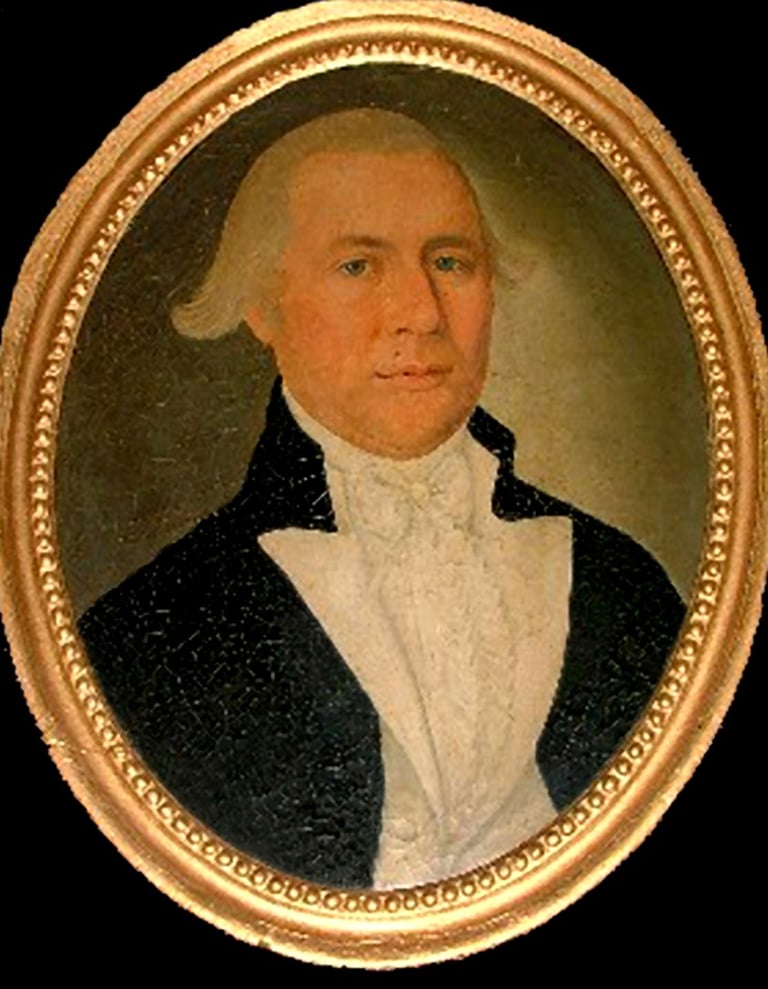
At one time, the Gisby family were also in possession of a portrait of Marshall, reportedly painted by a Chinese artist in Canton in late 1788 (a copy of which is reproduced at the head of this newsletter).
Marshall’s Background
From the fragments of the memoir which have emerged, we know that his father was Robert Marshall, from the Isle of Thanet in Kent. Parish records say that young John was baptised at St Lawrence Thanet on the 12th of February 1748, and we know from a First Fleet journal that Marshall celebrated his 40th birthday in Sydney Cove on the 13th of February 1788.
His father was working as a pilot out of Ramsgate in November 1755, when the vessel he was shepherding struck the Goodwin Sands and sank. After spending all day rescuing the survivors under freezing conditions, Robert Marshall passed away from exposure the following morning.
John went to sea at the age of ten, as an apprentice in the North America and West India trades, almost certainly in the employ of one of his uncles, for whom he worked over a number of years.
One of the frustrating features of the memoir is that it contains very few dates, although it is possible to nail down some of the timing based on the details provided. Marshall says that he got himself shipped as chief mate on a ship based out of Scarborough, carrying military stores to the West Indies with Admiral Rodney, which dates this voyage to 1781. It is likely that this vessel was owned by the Hopper family of Scarborough, owners of the Scarborough.
The earliest external evidence of Marshall having command of his own vessel dates to September 1782, when the Hopewell, owned by the Hoppers, arrived at Cowes in the naval transportation service. By August 1784, and possibly as early as May of that year, he had command of the Scarborough, voyaging into the Baltic for lumber. And in 1785 and 1786, he sailed several times to Savanna-la-Mar, on the island of Jamaica, for logwood and fustock, mahogany and pimento.
He had been back from Jamaica for less than a week when, in September 1786, the Scarborough was offered to the Navy Board for Australia’s First Fleet. The fragments of the memoir which have emerged say nothing about this period of his life, nor of his experiences on the First Fleet – one of the reasons why historians of early European Australia are keen to see the full document.
The Scarborough (1790)
The period of his life for which we have the most comprehensive account relates to his voyage to NSW on the Scarborough in 1790, as part of Australia’s Second Fleet. These details come from a children’s story published by one of Marshall’s descendants in 1888, which was based on the memoir.
Amy Walton, a successful author of the late 19th century, was John Marshall’s great granddaughter. Her paternal grandparents were Marshall’s daughter, Dorothy, and Charles Walton, the son of Captain Francis Walton, the master of another First Fleet ship, the Friendship, who (according to family history) had become a friend of Marshall’s.
In a children’s book published in 1888, Amy Walton included a chapter about the experiences of ‘Captain Enticknapp’ in seeing off a convict mutiny on a voyage to NSW. A note at the end of the chapter makes it clear that this was based on the memoir:
'The account of the convicts’ mutiny is taken from the unpublished diary of Captain John Marshall, in command of the ship Scarborough at the time.' [4]
We know a little of the Scarborough conspiracy from other sources. In a brief account written shortly after these events, Lieutenant John Shapcote, the naval agent accompanying the fleet, reported that Marshall had advised him of a plan by 17 of the convicts to take the ship. He had gone on board and conducted an inquiry, finding most of them guilty. Several who would not confess were punished, and five were confined, to be punished on arrival in NSW. [5]
Marshall had been informed of the planned uprising by a young middle-class convict named Samuel Burt, who had committed a forgery in the expectation of being found guilty and hanged, which he saw as a way of ending the pain of unrequited love. Burt had enjoyed the freedom of the deck since shortly after coming on board. Major Francis Grose, the officer commanding the NSW Corps, had visited the ship before the Second Fleet sailed and asked Marshall to pay particular attention to young Burt, whose family he knew. Because he was unchained, Burt was potentially of great value to the conspirators, which is why they had informed him of their intentions.
Some details of these events have been known because of a letter which Burt wrote to the barrister who had represented him at the Old Bailey, the renowned William Garrow. He explained that he had played along with the conspirators, and having learnt the details of their scheme, he apprized the Captain and the military officers, with the result that the ringleaders were all detained.
'The parties being examined, they made such confessions that human nature would almost shudder at the thoughts of:– several of them have been flogged with the greatest severity, and others of more dangerous description are at this time chained to the deck, and it is supposed will be tried and executed immediately on their arrival at New South Wales.'
He concluded his letter by noting that he was writing from Captain Marshall’s cabin, where he had been housed since his disclosure of the intended mutiny (for the obvious reason that he would no longer be safe down in the prison). [6]
Marshall’s memoir (as rewritten in Walton’s children’s story) gives us more detail of these events. Following Major Grose’s request, Marshall said that he had kept an eye on young Samuel Birt (as the name is spelt in the book).
'He was a slight young fellow of about twenty, with delicate features and large melancholy eyes which he bent on the ground; so shame-faced and sad looking, and such a contrast in his bearing to the recklessness of many of the other men, that my father’s heart was at once touched with pity for him.
'On the voyage he took every possible occasion of being kind to Birt, and allowed him the privilege of being on deck all day instead of only two hours like the rest of the convicts. He also lent him books, encouraged him to talk of his troubles, and by degrees learned the whole story of his misfortunes.'
According to this account, ‘Birt. . . would have done anything to serve the captain’ and was shortly given the opportunity to do so.
'At night the convicts were all locked down under hatches and sentinels placed over them. The men lay six in a berth, and it so happened that one of these disclosed to Birt a plot that forty of them had made and signed with their blood. Would he join them and have his share of the prize?
'Now Birt dared not say no, for he feared for his life amongst those desperate men.
‘"Before I say that I will," he replied, "I must know your plan. How is it possible to seize the ship when such a good look-out is kept?"
'Then the convict told him all that had been settled by the mutineers. At four o’clock when the hatches were raised most of the officers went to their cabins, and there would be more than twenty convicts on deck who were all in the plot. They would then knock down the sentinels, get possession of the quarter-deck, and seize the firearms which were ready loaded. They would next release their other comrades and alter the course of the ship.
‘"But what," asked Birt, "will you do with the captain, officers, and soldiers?"
‘"We will kill the captain," replied the wretch, "and put his head at the main topgallant masthead—and we will put the first-mate’s head at the mizzen, and the boatswain’s at the fore. The other convicts who are not with us in the matter we shall put on shore at some island, and leave them to shift for themselves, they are worth nothing. The ship is a good prize, for the captain has a large sum of money on board to take out for the East India Company. These things done, we shall kill the great hog, and with plenty of drink we shall have a good time of it. Do you join us?"'
Birt consented, but knowing that he would now be closely watched, he needed to how find a way of communicating the plan to Captain Marshall.
'In the morning when he went on deck he washed a shirt and took it up to the foretop to dry. . . Birt had a little pocket book with him, and in it, as he sat on the foretop, he wrote down all he knew about the intended mutiny. When he went below he hoped to get a chance of slipping it into the captain’s hand, or of putting it where he would be likely to find it.
'But luck was against him, for he could not get near the captain the whole of that day, and there were keen eyes always fastened upon him by the convicts, who were on deck by fifty at a time, and watched each other closely for fear of treachery. Amongst each fifty there were always some who were in the plot, and if they had suspected Birt of betraying them they would have made short work of him, and this he knew very well. Evening came, and still he had been able to do nothing. The next morning at four o’clock the bloody deed was to be done. . . Then he noticed that the first mate was [on the between deck], serving out water, and suddenly an idea came into Birt’s head. He pretended to stumble, threw himself right down the hatchway as though by accident, and fell a distance of sixteen feet into the [between deck]. As you may imagine all was immediately stir and excitement, for at first they thought he was killed—and, indeed, he was badly bruised, having fallen on to a water-cask. In the bustle, however, he managed to slip the book into the mate’s hand, and the thing was done. The surgeon was sent for and they got him up on deck, where, while his hurts were being looked to, he had the satisfaction of seeing the mate go aft and then into the captain’s cabin.'
In Walton’s version, when the convicts were all called on deck and confronted with the news that their conspiracy had been discovered, there was a struggle. Some of them got hold of the soldiers’ firearms and in the melee, Captain Enticknapp was twice wounded. It was at this time, she wrote, that the Captain’s old watch had saved his life. Based on Burt’s letter to Garrow and the inscription which accompanies the watch, this is fiction and was not part of Marshall’s original account.
'. . . the convicts, being overpowered, were secured under hatches again, and the captain then made Birt point out the ringleaders and the most desperate of the men, which he did to the number of thirteen. These were placed in irons for the rest of the voyage, and when the vessel arrived at Port Jackson it was supposed they would have been hanged. But the governor declaring that it was not in his power to do so, they were registered to be kept in irons, chained two and two together, all their lives long.'
According to Walton, Burt was pardoned because of the service he had rendered to the ship. He never returned to England, and, settling down in China, where he prospered. He corresponded with Marshall for some years, who ‘always spoke of him with affection’. [7]
This is a somewhat abbreviated account of Samuel Burt’s redemption. On arrival in the colony, he was given a job in the government clothing store, in part, as a reward for his actions on board the ship. But he was also literate and numerate, competencies that were of great value in the administration of the settlement. David Collins wrote that Burt and another clerk had conducted themselves with the greatest propriety and ‘beheld with joy the probability that appeared of their being again considered and ranked in the class of honest men and good members of society’. [8]
His life sentence was reduced to seven years, and then in January 1794, Major Grose, now the Acting Governor, granted him an absolute pardon:
'. . . because of his good conduct in discovering and thereby preventing the intended mutiny on board the 'Scarborough' in her voyage to this country in the year 1790, and his faithful services in the public stores under the commissary since his arrival.' [9]
Burt sailed from NSW on the Surprize in December 1794 and, contrary to Walton’s account, arrived back in England in May 1796. It is plausible that he later made his way to China, possibly on a ship commanded by John Marshall.
Marshall’s Later Years
Following his return from NSW a second time, Marshall was engaged to take the Renommée to China for a cargo of tea. The ownership of this vessel is unknown, but she was sailing out of Ostend under Genoese colours and under the notional command of an Italian captain, to get around the East India Company’s monopoly over British trade with India and China.
On this voyage, they carried out a cargo of rabbit and fox skins and safely returned in August 1793 (war had broken out with France) with tea and sugar, silks and cottons. Marshall took her to China a second time in 1794, but according to the memoir, on his return, he took the ship to St Bartholomew in the West Indies, out of a concern that his presence on board would give French privateers a reason to seize her as a prize. He had a tempestuous return to England, with three of the seamen and a cabin boy from the ship being washed overboard and drowned.
In January 1797, as Marshall was returning from the West Indies once again as a passenger on the Diana, the ship was attacked by a French privateer. According to newspaper reports:
'For the few minutes the privateer was alongside of the Diana, and in the act of throwing her men on board her, the conflict was of the most severe kind. The French officers, with their swords, were seen beating and forcing their men upon the Diana; whilst on the other side, the crew of the Diana fought hand to hand. One Frenchman was found killed upon the Diana’s deck; several were wounded, others forced into the sea, and drowned; and ten more were found on board, and hanging off the outside of the Diana; these were taken in, and afterwards dispersed on board the different vessels. On board the Diana, the Captain and two seamen were killed. Capt. Marshall, a passenger, and ten seamen wounded.' [10]
As the inscription accompanying the damaged watch attests, Marshall was struck twice, one ball passing through his body, the other striking the watch and penetrating his thigh.
On his return, Marshall retired from the sea, opening a flour mill, bakehouse and shop at Ramsgate. As the memoir recalls:
'My business at London being finished, I went home to my wife & family at Ramsgate. After being there some time, I was advised to leave the sea, & endeavour to get a living on shore. My friends persuaded me to build a windmill for grinding corn, & thought that I would get a good livelihood. I took some time to consider of this, &, at length, acceded to their advice.'
The milling business was not a success, but the bakehouse did well, and in 1798, Marshall built ‘Albion House’ on top of a hill at Ramsgate, overlooking the sea, which he later sold to Lady Augusta Murray. Around 1813, he bought a share in a cutter, with the intention of contracting her to the Royal Navy, but peace was finally negotiated in 1815, and the cutter was laid up and then sold at a considerable loss.
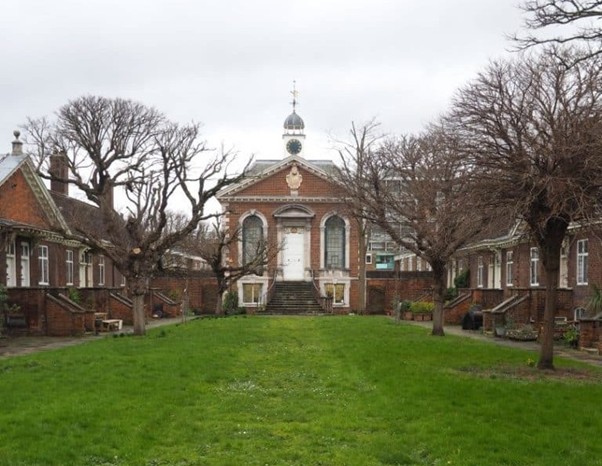
In 1818, Marshall petitioned Trinity House for a pension, the application being signed by an agent for the Hopper family, his former employers. He and his wife Mary moved into a Trinity House almshouse in Mile End Road at Bethnal Green (now Whitechapel). Marshall passed away the following year and was buried at St Dunstan Stepney. Mary would live in the small community of retired sea captains and their wives for another two decades.
_________________________
In the interests of length, this newsletter has not been fully referenced. Readers interested in tracking particular sources are welcome to contact the authors.
[1] Daniel Southwell to Jane Southwell, 20 August 1790, BL Add Mss 16381, Letters from D. Southwell Concerning New South Wales, 1783-1793, p.87; Elizabeth Macarthur, ‘Some Early Records. . .’, pp. 13-14, 17-18.
[2] David Collins, An Account of the English Colony in New South Wales, London: Cadell and Davies, 1798, p. 123.
[3] Ibid., p. 124.
[4] Amy Walton, Susan, London: Blackie & Son. [1888], p.167.
[5] Shapcote to the Navy Board, 22 February 1790, UK National Archives (hereafter TNA) T1/687/162.
[6] Burt to a gentleman of Lincoln’s Inn, 18 April 1790, Public Advertiser, 18 October 1790.
[7] Amy Walton, op. cit., pp. 259-167.
[8] David Collins, op. cit., pp. 238-239.
[9] Ibid., p. 342.
[10] Leeds Intelligencer, 20 March 1797.
Captain John Marshall, said to have been painted by a Chinese artist at Canton in 1788, in the possession of his descendants.
Trinity Green, Whitechapel - John Marshall's Final Home
Contact us
Botany Baymen acknowledges the traditional custodians of country throughout Australia and respects their connection to land, water and community.
© Botany Baymen 2024-2026. All rights reserved.
You may download, display, print and reproduce this content for your personal or non-commercial use but only in an unaltered form and with the copyright acknowledged.
Privacy Policy

Subscribe to our latest updates
Be the first in the know. We promise no spam.