Missing Manuscripts 1: Richard Williams' Journal
A number of personal letters and journals from the First Fleet are missing. One of those, from which we have extracts, is the journal of a mariner who sailed on the Borrowdale, one of the store ships which accompanied the fleet.
Gary L. Sturgess
4/19/20263 min read
A significant number of personal letters and journals from the First Fleet are missing - we know of some of them because they are referred to in surviving sources. The men and women who were part of this expedition understood its historic significance (which is why so many letters and journals were written), and it is difficult to believe that the majority of them were not preserved by family and friends. The recent emergence of the personal journal of Arthur Phillip, Commodore of the fleet and Governor of the colony, is evidence that original manuscripts are still out there.
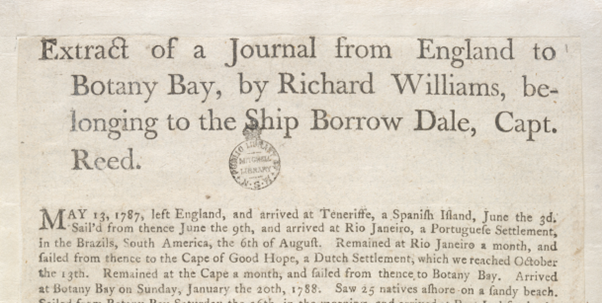
Among those that I would particularly like to see is the journal of Richard Williams, second mate of the Borrowdale, one of the storeships which accompanied the fleet. We know of his journal through a broadsheet published in London on his return, which includes several tantalising passages.
The broadsheet begins and ends with a brief account of the voyage out and back, too brief to offer anything new. However, it is from Williams that we learn that the subject of the sermon delivered by Reverend Richard Johnson at the first divine service held on the grass on the western side of the settlement on the 3rd of February, in ‘a mizzling rain’ – was Psalm 116:12: “What shall I render unto the Lord, for all his benefits towards me?”
But what interested the editor of this broadsheet most, and is most intriguing to readers today, is a series of entries describing Williams’ encounters with Aboriginal families up and down the harbour. These are some of the most intimate accounts of the ‘dancing with strangers’ moments in the earliest encounters between these two utterly different peoples. And Williams is unusual in that he almost always mentions the children.
On the 25th of March, he writes that he ‘spoke with’ (whatever that involved, given they did not speak each other’s language) four of ‘the natives’ – this was undoubtedly somewhere along the harbour, when he was fishing for the ship’s company. Two days later, he saw a number of canoes, ‘and spoke with one fishing under a large rock. Having a man, a woman, and two children on board’. Then on the 18th of April:
'. . . in the morning we went up the river about two miles, with our long and small boats. Parted company with our small boats, having on board 5 men, including myself. At a quarter of a mile distant turned a point of land and surprised 4 canoes of the natives, they had a fire ashore, and were enjoying themselves, but on seeing us they immediately fled, leaving behind their canoes, containing fishing implements, a shield made from the bark of a tree, a Calabash shell with food, which was chiefly fish. One of their children we soon overtook, who seemed much affrighted, cried greatly, and began to climb the rocks, &c to escape. Three of the men savages, who were quite naked, returned and sat down with us by the fire for near an hour.'
It is from Williams that we get the earliest description of an Aboriginal child, his hair decorated with the feathers of a sulphur-crested cockatoo:
'The child was about two feet and half high of a chocolate colour, well proportioned, short, black curly hair, ornamented each side of his head with small fish bones, and behind two bunches of white and yellow feathers, from bird called a Cockatoo, cemented to small locks of hair with gum.'
On the 27th of April, they were down the harbour, with eight convicts in the ship’s boats.
'We put into a bay about two miles and a half from where the ships lay, and spoke with some of the natives, (men) who had three children with them, one of which was an infant, whom I took in my arms.'
A group of Aboriginal and European men encounter each other somewhere along Sydney Harbour. They ‘speak’, whatever that means, and Williams asks, and permission is given, to hold an infant in his arms.
Williams records some of the earliest of the violence – the killing of the two rushcutters in late May ‘in the most barbarous manner’ – but he has also left us the most vivid accounts of the friendly interaction which also occurred in those first few months of the settlement.
The Borrowdale sailed from NSW in July 1788 after less than five months in the colony, but these fragments leave me wondering what’s in the rest of Williams' journal.
_________________________
The broadsheet can be found at the State Library of NSW, DSM Q991W.
Contact us
Botany Baymen acknowledges the traditional custodians of country throughout Australia and respects their connection to land, water and community.
© Botany Baymen 2024-2026. All rights reserved.
You may download, display, print and reproduce this content for your personal or non-commercial use but only in an unaltered form and with the copyright acknowledged.
Privacy Policy

Subscribe to our latest updates
Be the first in the know. We promise no spam.