
Lying for the Admiralty?
Was there a race between the British and the French in the years 1786 to 1788 to claim Botany Bay? Was the deepwater harbour at Port Jackson secretly discovered by James Cook in 1770, and was this the real reason the British settlement was established there? There are central claims made by Sydney author, Margaret Cameron-Ash, in a revisionist history of the origins of European Australia. This newsletter examines her evidence and finds it wanting.
Gary L. Sturgess
1/26/202625 min read
A Revisionist History
For several years, Sydney author Margaret Cameron-Ash has expounded her revisionist account of the European settlement of Australia, claiming that James Cook secretly discovered Port Jackson in 1770, and that the penal settlement was established there in 1788 because of French plans to claim the east coast of New Holland for themselves.
The Australian and The Great Circle, the journal of the Australian Association for Maritime History, have published her articles. She has spoken at the Sydney Institute, the Institute of Public Affairs, the Centre for Independent Studies and the Captain Cook Society, and many others, and on the 7th of February 2026, she will speak to the Fellowship of First Fleeters, at their annual celebration of the settlement’s foundation.
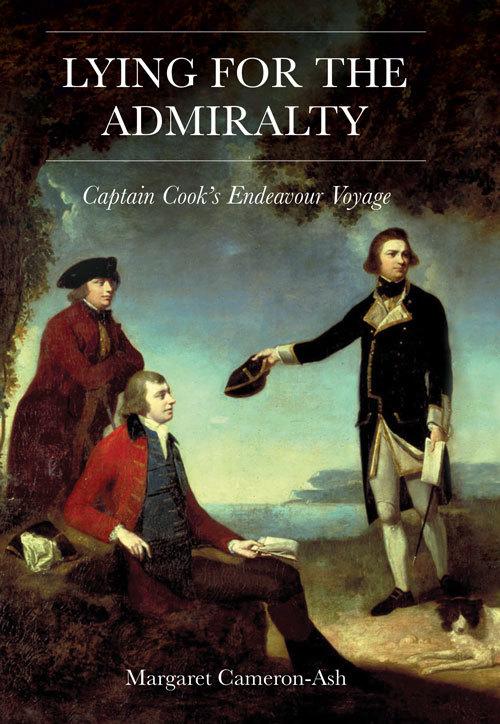
In her first book, Lying for the Admiralty, published in 2018, Cameron-Ash argued that in his exploration of the Pacific in 1769 and 1770, James Cook had secret instructions from the Admiralty, and that he concealed his most important discoveries, including the existence of a vast deepwater harbour at Port Jackson on the south-east coast of New South Wales. The blurb on the cover of her book claims:
"With a detective’s instinct, the forensic skill of a lawyer, and an eye for engaging detail, Cameron-Ash re-examines Cook’s original journals and charts with all their erasures, additions, omissions and fabrications."
Beating France to Botany Bay (2021), her second book, claims to rewrite the story of the founding of modern Australia. According to the promotion for that book, Cameron-Ash:
". . . tells how the French had a jump start in the race for a Pacific empire, but English officials then launched their own pursuit around the globe. The contestants finally met in Botany Bay, with the French just five days too late."
These propositions have remained largely unchallenged. There have been several unfavourable reviews, but Cameron-Ash responds to her critics by asserting that after 30 years of research, her books are ‘crammed with primary sources and archival evidence’. [1] Her challenge to those who disagree is that they produce the evidence.
This newsletter takes up that challenge by turning to the primary sources and examining two of her core propositions – (i) that the commodore of Australia’s First Fleet, Captain Arthur Phillip, had been secretly briefed on Cook’s discovery of Port Jackson, and that from the outset, that harbour (and not Botany Bay) was the intended place of settlement; and (ii) that there was a race between the British and the French to claim NSW as their own.
The Secret Discovery of Port Jackson
A central assertion in both books is that while the Endeavour was anchored in Botany Bay in April 1770, Cook and several ‘trusted men’ explored the northern side of the bay and stumbled across Port Jackson. This was a secret kept from the rest of the crew and all but a small group at the top of the Admiralty, because of the strategic significance of a sheltered deepwater port in the south-west corner of the Pacific.
In Lying for the Admiralty, she gives a detailed (but admittedly ‘speculative’) account of Cook’s trek across the sandhills, although the expedition itself, the concealment of the discovery, the secret report to the Admiralty and the communication of that report to Arthur Phillip are presented as established facts. To her, the failure of Cook to mention these events in his journal is proof that they occurred: ‘His vagueness is deafening.’ [2]
The more obvious explanation for this silence is that these events never occurred, so what is the basis for her claim?
Upon analysis, it turns out that her entire hypothesis rests on a single piece of evidence, an enclosure to a letter from Phillip to the Under Secretary of the Home Office, Evan Nepean, dated 11 April 1787, a month before the First Fleet sailed. The relevant passage reads:
"It must be left to me to fix at Botany Bay if I find it a proper place. If not, to go to a port a few leagues to the northward, where there appeared to be a good harbour, and several islands. As the natives are very expert in setting fire to the grass, the having an island to receive our stock would be a great advantage, and there is none in or off Botany Bay." [3]
There is no mention here of Port Jackson, but Cameron-Ash argues that it was the only inlet with islands a few leagues to the north of Botany Bay, and since the Endeavour did not sail into Port Jackson on its way up the NSW coast, and the islands in that harbour cannot be seen from outside the heads, Cook must have discovered it while the ship was anchored in Botany Bay. As she sees it, there can be no alternative explanation.
And since (as she sees it) Phillip was referring to Port Jackson in this letter, he must have been briefed about Cook’s secret discovery, and all of the talk about Botany Bay was a feint to mislead the French.
The Context of Phillip’s Letter
The Cameron-Ash hypothesis turns on how we interpret the enclosure to Phillip’s letter of the 11th of April. On a plain reading, Phillip was simply asking the permanent secretary of the Home Office, the man who had developed the plans for a penal settlement in NSW, whether he had permission to look elsewhere if Botany Bay proved to be unsuitable.
This letter was one in a series, commencing on the 27th of December 1786, in which Phillip sought to clarify the limits of his authority. For example, on the 1st of March 1787, he put a series of propositions to Nepean seeking his confirmation or rejection. One of these read:
"That I should be able to make the settlement in such port as I may find the most convenient and best to answer the intentions of Government." [4]
Nepean’s response is not in the archives, and Phillip’s letter of 11 April is his reply to that missing letter.
Nepean’s Knowledge
These letters were confidential communications between two senior officials of the British government. There was no expectation that they would become public and there was no need for them to speak in cryptic terms, unless Phillip had been briefed about Port Jackson and Nepean hadn’t. Given the latter’s standing in the government, this is unimaginable.
Evan Nepean was the departmental secretary in charge of the Home Office, serving the minister most intimately involved in dealings with the King. He was routinely entrusted with highly sensitive matters of state, he was personally responsible for international espionage, and he had overseen a recent investigation into an assassination attempt on the King.
If there had been a confidential report on Port Jackson or if Philip Stephens, the secretary of the Admiralty, knew about Cook’s discovery of the port, Nepean would have been aware of it.
He was responsible for planning the intended settlement. He was in communication with Sir Joseph Banks – the botanist who accompanied Cook on his first voyage, and the leading British authority on the Pacific – gathering whatever information was available about Botany Bay. Evan Nepean’s security clearance was significantly higher than Arthur Phillip’s and Philip Stephens had an obligation to provide this information to Nepean as he was preparing the Cabinet submission.
Dividing the Fleet
Phillip was conscious that they knew very little about Botany Bay, and on a careful reading, Cook’s description was not especially encouraging. The Governor-designate was asking whether he had the authority to establish the settlement somewhere else if Botany Bay was not appropriate.
The response was sent nine days later by the Home Secretary, Lord Sydney. He confirmed that Phillip had permission to select another site, but he was given very little latitude:
"There can be no objection to your establishing any part of the Territory or Islands upon the Coast of New South Wales in the neighbourhood of Botany Bay which you may consider as more advantageously situation for the principal Settlement, But at the same time you must understand that you are not allowed to delay the disembarkation of the Establishment upon your arrival on the coast upon the pretence of searching after a more eligible place than Botany Bay." [5]
This created a dilemma: Phillip was instructed not to delay the disembarkation of the convicts and marines once they arrived, but he needed time to be certain that Botany Bay was fit for purpose. There is an undated note by Phillip which suggests that he was worrying about this problem: ‘I may add the short space of time left to choose a proper situation’. [6]
The solution, Phillip thought, lay in sailing ahead of the convoy in one of the faster vessels, to ascertain whether Botany Bay was suitable, and if not, to select another location before the bulk of the convicts arrived. This is the approach which he eventually adopted. David Collins, who sailed with him on the Sirius and would become the Governor’s official secretary, wrote:
"On the 16th, Captain Phillip signified his intention of proceeding forward in the Supply, with the view of arriving in New South Wales so long before the principal part of the fleet, as to be able to fix on a clear and proper place for the settlement." [7]
Cameron-Ash provides none of this context in her discussion of Phillip’s letter.
Ports to the North of Botany Bay
For her chain of logic to hold, Phillip cannot have been considering alternatives other than Port Jackson. There are three major harbours to the north of Botany Bay which were mentioned by Cook in his journal: Port Jackson, Broken Bay and Port Stephens.
Broken Bay has one large island which is visible from the sea, but Cook made no mention of it because the Endeavour crossed the entrance shortly after sunset. Of Port Stephens, however, Cook wrote:
". . . at the entrance are three small islands, two of which are high; and on the main near the shore are some high round hills, which at a distance appear like islands. . ." [9]
Given that Cook had almost nothing to say about Port Jackson and Broken Bay, the most obvious conclusion is that Phillip was thinking about Port Stephens. This was suggested by Gordon Barton in a footnote to the History of New South Wales from the Records, written in the 1880s. [10] Cameron-Ash dismisses this as a possibility because Port Stephens is more than 30 leagues away, not the few leagues mentioned in Phillip’s memorandum. [11]
This would be a reasonable point of rebuttal, except there is contemporary evidence which clearly states that Phillip was thinking of Port Stephens. Under the date of the 19 November 1787, at the time when Phillip separated the fleet and sailed ahead in the Supply, his aide-de-camp, Lieutenant Philip Gidley King, noted in his journal:
". . . the governor flatters himself that he shall arrive at the place of our destination (Botany Bay) a fortnight before the Transports in which time he will be able to make his observations on the place whether it is a proper Spot for the Settlement or not & in the latter case he will then have time to Examine Port Stephens before the arrival of the Transports on the Coast; Should Botany Bay answer our expectations he may have time to erect a Log Store house for the reception of the Provisions which will hasten the departure of the Store Ships & Transports." [12] (emphasis added)
In the Fair Copy of his journal, written up some time after the landing at Sydney Cove, King did make reference to Port Jackson, but he also noted that Phillip was considering other northern harbours:
". . . to determine whether that, is a proper place for the Settlement to be fixed at, & if not, it is his intention to Examine Port Jackson & the other ports to the Northward. . ." [13] (emphasis added)
Based on these sources, Phillip was thinking of Port Stephens as the leading alternative, at least in November 1787.
Sailing for Broken Bay
In the result, Phillip arrived in Botany Bay just a few days ahead of the fleet, and it was probably for this reason, and the time that would be lost in sailing so far north, that Port Stephens was dropped from consideration.
There is clear evidence, however, that when he sailed from Botany Bay on the morning of 21 January to investigate the northern ports, his primary destination was Broken Bay. There are three contemporary journals which state that Phillip was making for Broken Bay.
· Marine Lieutenant Clark wrote that Phillip had sailed for ‘Brocking Bay’, with no mention of Port Jackson.
· Midshipman Daniel Southwell wrote in his journal under 21 January: ‘The comander and officers surveying the neighbouring part of the coast, called Broken Bay; the party have taken 3 days' provisons, some tents, &c., &c’.
· Marine Private John Easty initially thought that Phillip had gone to Broken Bay but later crossed those words out and wrote ‘Port Jackson’ above the line.
On 23 January, the day that Phillip returned, the surgeon of the Lady Penrhyn, Arthur Bowes Smyth, was confused about where they had gone, describing it as ‘Port Jackson, Broken Bay’. And Philip Gidley King and David Collins, who were close to Phillip and careful record keepers, wrote of him heading for Port Jackson and Broken Bay. [14]
There are a number of other sources which only refer to Port Jackson, but they were all written after Phillip’s return to Botany Bay on 23 January, by which time he had decided on Sydney Cove as the site for the settlement. All of the sources which only mention Broken Bay were written prior to that date.
In Beating France, Cameron-Ash acknowledges that some of the First Fleet journals do mention Broken Bay, but she dismisses them as a mistake, either by Phillip or the journal keepers, since the expedition sailed with only three days’ rations, which would not have sustained them on a voyage to Port Jackson and Broken Bay. [15] The mistake, if there was one, was Phillip’s: the evidence that prior to sailing he was talking with his officers about Broken Bay is unassailable.
Phillip was intending to investigate Port Jackson on his way north: it had been mentioned by Cook, albeit only in passing, and Phillip knew as much about it as he did about Broken Bay. But if there is evidence that in writing to Nepean in April 1787, Phillip was contemplating Broken Bay and/or Port Stephens as alternatives, then Cameron-Ash’s chain of logic falls apart, and there is no hard evidence that Phillip knew about Port Jackson prior to his sailing into the harbour on 21 January.
And if that is the case, there is no evidence of a secret briefing from the Admiralty or a secret discovery by Cook.
Phillip’s Conduct at Botany Bay
If, as Cameron-Ash asserts, Port Jackson was always the intended place of settlement, why did he not take the fleet there direct? Her response is that the entrance to the harbour had never been sounded, and ‘Phillip could not risk taking 1500 souls onto a hidden sandbar’. The fleet was to rendezvous at Botany Bay while a quick survey was made of Port Jackson.
Except that isn’t what happened. On their arrival, Phillip invested a huge amount of effort into exploring Botany Bay and the two rivers which feed into it. Convicts were landed, a watercourse was cleared and a sawpit was dug in anticipation of building a settlement there. Even as he was setting off to explore the bays to the north, he instructed his lieutenants to keep exploring the surrounding countryside in hope of finding a suitable site, and to continue with the construction of the sawpit on the southwest shore.
If Phillip was always intending to plant the settlement in Port Jackson, then upon arrival, he would have immediately taken the Supply there and surveyed the entrance to the harbour for reefs and sandbars. This need not have taken long – when he sailed into Port Jackson on the 25th of January (in the Supply), they only spent an hour or two being cautiously towed by the ship’s boats around the reef known as ‘the pig and sows’, before setting sail. Why persist with such an elaborate and time-consuming ruse?
Phillip’s Behaviour on Discovering Port Jackson
Cameron-Ash also needs to explain Phillip’s reaction on sailing into Port Jackson for the first time on the 21st of January. According to David Collins, who accompanied this expedition, Phillip was surprised by what they discovered.
"The coast, as the boats drew near Port Jackson, wore so unfavourable an appearance, that Captain Phillip’s utmost expectation reached no farther than to find what Captain Cook, as he passed by, thought might be found, shelter for a boat. In this conjecture, however, he was most agreeably disappointed." [16]
Hunter, the second captain of HMS Sirius, was also present that day. In his original journal, he made clear that their destination was Broken Bay, but they stopped to investigate a large opening three and a half leagues to the north of Botany Bay:
". . . it had rather an unpromising aspect on entring [sic] between the outer heads or Capes which form its entrance, which are High rugged & perpendicular Cliffs, but we had not gone far in before we discovered a large Branch extending to the Southward; into this we went, and soon found ourselves perfectly land lockt [sic] . . ."
Hunter mentioned that Cook had noticed this inlet as he sailed along the coast:
". . . but he did not enter it & was therefore uncertain of there being a safe Harbor here, it has the appearance from Sea of being an open Bay." [17]
Both of these officers were agreed that Phillip had low expectations as they approached the heads and was surprised to discover ‘the finest harbour in the world’.
When Captain Hunter arrived at the Cape in the Sirius in January 1789 to purchase additional provisions for the settlement, he wrote to the Admiralty, advising them of the settlement's relocation to Port Jackson:
"I think it necessary in case Governor Phillip’s Dispatches by the above Transports, should not have arrived before this may reach the Admiralty, to mention for the information of their Lordships; that the [illegible] of Port Jackson which is about 4 Leagues to the Northward of Botany Bay, having been explored, and found a Safe, Extensive, and Commodious Harbour, the Governor had fixed the seat of Government there, instead of Botany Bay. . ." [18]
This communication makes no sense if Hunter was aware of secret instructions from the Admiralty, and once they were firmly established in Port Jackson, Phillip had no reason to conceal the fact that he had been briefed about the harbour prior to sailing from England. There was certainly no need for Collins to do so ten years later when his Account was published.
Beating the French
Cameron-Ash’s second book is based on the proposition that Australia’s First Fleet was commissioned in haste because of information Prime Minister William Pitt received regarding a French plan to establish a colony in New Holland, using the French explorer, the Comte de La Perouse.
She claims that on the 17th of August 1786, Sir Joseph Banks met with John Ledyard, an American-born adventurer who had sailed with Cook and had (allegedly) learned about the French plans whilst in Paris.
In her 2022 article for The Great Circle, Cameron-Ash insisted that proof of this meeting could be found in American archives, but a careful reading of Beating France reveals no such evidence. While she has sources describing what Banks and Ledyard were doing in London at different times throughout the month of August, none of them mentions a meeting between these two men.
She provides a detailed description of this meeting, without any sources. Her account is peppered with ‘probably’, ‘undoubtedly’ and ‘would have’, although at times she feels so confident about what must have happened that she tells us precisely where Banks was standing when they met, and how he reacted to different parts of the conversation. As soon as Ledyard had left, Banks ‘undoubtedly’ hurried over to Whitehall to inform his friends.
"In a matter of minutes, the news would have reached the Prime Minister at Number Ten, Lord Sydney and Evan Nepean at the Home Office and Phillip Stephens at the Admiralty." [19] (emphasis added)
Here, at the heart of her thesis, we find not primary sources, but supposition piled upon supposition.
The Botany Bay Decision
Turning to the archival evidence, it is clear that there was no rush of blood to the government’s head on the 17th and 18th of August. Nepean had been preparing a Botany Bay option for at least seven months, and the papers which Lord Sydney took to Cabinet, probably on the 18th, contained detailed calculations which could not have been prepared overnight.
Cameron-Ash is right to say that the decision to establish a penal colony in the south-west corner of the Pacific was influenced by larger geopolitical issues, but there is no question that the government was also concerned about the build-up of convicted felons in the hulks and prisons.
Cabinet had discussed the problem at a meeting on the 1st of June, and when Lord Sydney met with the commander of HMS Nautilus on the 24th of July and was told that the south-west coast of Africa was unsuitable for a penal settlement, it was essential that they find an alternative. South-west Africa was of little strategic significance to Britain, and yet the government had dispatched a ship to investigate whether convicted felons might be sent there.
Nepean was busy in the first weeks of August, among other things, leading an investigation into Margaret Nicholson, the woman who had just made an attempt on the King’s life. But the ‘Heads of a Plan’ for a penal settlement at Botany Bay and the associated calculations must have been developed in this period. Nepean had a personal secretary, but almost all of the Home Office staff were copyists, and he did this kind of policy work himself.
While I think it is likely that the Botany Bay decision was taken to Cabinet, and that the decision was made on Friday the 18th, it is important to note that we have no firm evidence of this.
Pitt did not always take matters before Cabinet, and there in no record of the Botany Bay decision until the following week. The great First Fleet scholar, Alan Frost, noted (correctly) that Sydney’s letter dated the 18th of August had been written on the 21st and backdated. Other contemporary documents suggest that it might not have been sent to Treasury until some days after that.
Minutes of Cabinet meetings were not usually kept, and the minutes of a Treasury Board meeting which actioned Sydney’s letter, allegedly held on the 18th, were clearly written some days later. (The Treasury was the Prime Minister’s department, and key decisions were formally taken by a board rather than just by the Prime Minister or his officers.)
It was not unusual for Treasury officials to make a decision and afterwards have it ratified by the Board, but on this occasion, they felt the need to backdate the decision rather than have it approved in retrospect some months later (the Board having adjourned for the summer).
It is possible – although there is no evidence of this – that Sydney took the matter to Cabinet on several occasions, testing his colleagues’ views and refining the proposal over time. One explanation for the backdated letter might be that following a wide-ranging discussion on the 18th and an audience with the King, Sydney and Nepean reworked their proposal to take account of the comments, and prepared the letter to the Treasury early the following week without taking it back to Cabinet.
But this is supposition. No one who has studied the original documents in detail could construct a narrative describing the events of the 17th and 18th of August with the confidence that Cameron-Ash has done.
It’s unlikely that this decision was prompted by news that the French were intending to lay claim to New South Wales. The British ambassador in Paris had been excited in June 1785 when La Perouse was preparing to sail for the Pacific, passing on stories (which proved to be untrue) that his ships would be carrying convicts and that he was intending to establish a settlement in New Zealand. If Pitt and his colleagues were not stirred into action by this intelligence from their ambassador, why would they have responded overnight to stories from an unknown American adventurer?
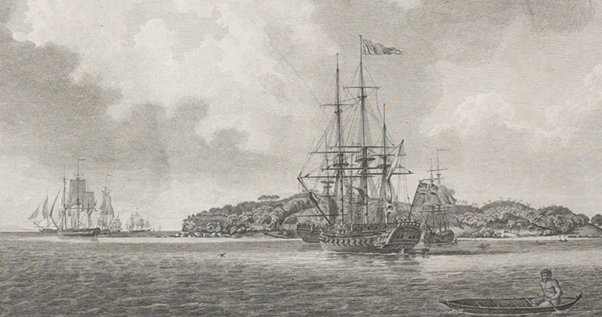
Detail of ‘A View of Botany Bay’ showing the First Fleet [8]
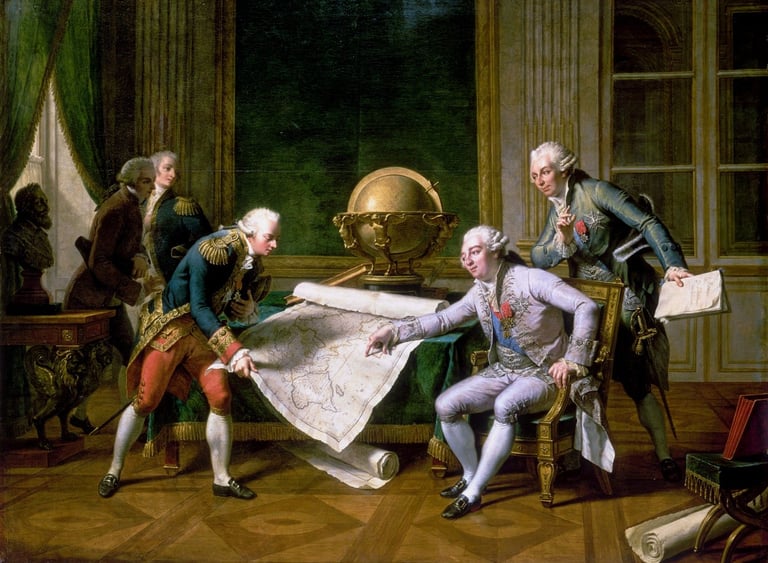
Louis XIV giving his instructions to La Pérouse, 29 June 1785 [20]
________________________
As usual, for reasons of space, this newsletter is not fully referenced. Readers who want to know more about particular details can contact the author.
[1] Margaret Cameron-Ash, ‘Penal Colony or Political Masterstroke? Australia’s Anglo-French Story’, The Great Circle, (2022), Vol. 44, No.2, pp.74-86 at p.81.
[2] Margaret Cameron-Ash, Lying for the Admiralty, Sydney: Rosenberg Publishing, 2019, p.172.
[3] Phillip to Nepean, c.11 April 1787, UK National Archives (hereafter TNA) CO201/2/128-131.
[4] Phillip to Nepean, 1 March 1787, TNA CO201/2/114-115.
[5] Draft of Sydney to Phillip, 20 April 1787, TNA CO201/2/135.
[6] Phillip, undated note, TNA CO201/2/88.
[7] David Collins, An Account of the English Colony [1798], Sydney: A.H. & A.W. Reed, 1975, Vol.1. p.lxxxvii. See also Philip Gidley King, ‘Remarks & Journal kept on the Expedition to form a Colony. . ., with additional information, 1786 - December 1790’, (Private Journal) SLNSW Safe 1/16, Volume 1, 19 November 1787.
[8] ‘A View of Botany Bay’ (detail), The Voyage of Governor Phillip to Botany Bay, London: J. Stockdale, 1789, opp. p.46.
[9] John Hawksworth, An Account of the Voyages. . . for Making Discoveries in the Southern Hemisphere, London: W. Strahan and T. Cadell, 1773, Vol.3, p.508.
[10] G.B. Barton (ed.), History of New South Wales from the Records, Sydney: Government Printer, 1889, Vol.1, p.46, note.
[11] Margaret Cameron-Ash, Lying for the Admiralty, op. cit., p.168.
[12] Philip Gidley King, ‘Remarks & Journal kept on the Expedition to form a Colony. . ., with additional information, 1786 - December 1790’, (Private Journal) SLNSW Safe 1/16, Volume 1, 19 November 1787.
[13] Philip Gidley King, `Remarks & Journal kept on the Expedition to form a Colony ...', with additional information, 1786 - December 1790; compiled 1790, (Fair Copy), SLNSW, C115, 19 November 1787.
[14] Ralph Clark, op. cit., p.91; Daniel Southwell, Journal, BL Add Ms 16382, 21 January 1788; John Easty, Memorandum of the Transactions of a Voyage from England to Botany Bay, 1787-1793, Sydney: Angus and Robertson, 1965, pp.91-92; Arthur Bowes Smyth, NLA version, op. cit., 23 & 26 January 1788; Phillip Gidley King, Private Journal and Fair Copy, op. cit., 21 January 1788; David Collins, An Account of the English Colony, op. cit., Vol.1, p.2.
[15] Margaret Cameron-Ash, Beating France to Botany Bay, Sydney: Quadrant Books, 2022, p.347.
[16] David Collins, An Account of the English Colony, op. cit., Vol.1, p.3.
[17] John Hunter, ‘Journal Kept on Board the Sirius During a Voyage to New South Wales, May 1787 – March 1791’, State Library of NSW, SAFE/DLMS164, p.35.
[18] Hunter to the Admiralty, 3 January 1789, Hunter Letterbook 1789-1792, TNA ADM1/1909.
[19] Margaret Cameron-Ash, ‘Penal Colony or Political Masterstroke?’, p.80; Cameron-Ash, Beating France, Chapter 28.
[20] Nicolas-André Monsiau, ‘Louis XIV Giving his Instructions to La Pérouse’, 1817, Chateau de Versailles.
[21] Fleurieu to La Perouse, 15 December 1786, Archives Nationales, Marine, 3JJ 386, transcribed and translated in Robert King, ‘What Brought Laperouse to Botany Bay?’, Journal of the Royal Australian Historical Society, (1999) Vol.85, No.2, pp.140-147, at pp.143-144.
[22] Margaret Cameron-Ash, Beating France, op. cit., p.329.
[23] Margaret Cameron-Ash, ‘Victorious First Fleet won Australia’s “Trafalgar Day”’, The Australian, 21 January 2022.
[24] La Perouse to de Castries, 28 September 1787, Archives Nationales, Marine, 3JJ 386, 111.2, no. 80, in John Dunmore (trans. and ed.), The Journal of Jean-François Galaup de Pa Pérouse, 1785-1788, London: Hakluyt Society, 1994, p.531.
[25] George B. Worgan, Journal of a First Fleet Surgeon, Sydney: Library of Australian History, 1978, p.30.
[26] Margaret Cameron-Ash, ‘Victorious First Fleet. . ., op. cit.
[27] Ibid.
[28] Ibid.
No Race for NSW (1)
The preparations for the First Fleet were anything but rushed. The convoy did not sail until May 1787, nine months after the decision was taken, and the voyage took another nine months, with stops at three foreign ports, two of them extended. That’s an 18-month delay in what Cameron-Ash believes to have been a race to beat La Perouse, who had sailed for the Pacific in August 1785.
The French King’s original instructions to La Perouse directed him (among other things) to explore the northern, western and southern coasts of New Holland. No mention was made of the east coast, because it had been thoroughly charted by Cook in 1770. No one (not even Cameron-Ash) has suggested that there were secret instructions.
And while he was at a Russian port at Kamchatka (in Siberia) in September 1787, shortly before receiving new instructions from his government, La Perouse wrote down his intended itinerary for the rest of his voyage, which reveals that he had no intention of sailing to the east coast of New Holland.
The Kamchatka Letters
Cameron-Ash argues that this changed when the French government learned about the plan to establish the penal colony, with dispatches being rushed to La Perouse at Kamchatka. (In truth, they weren’t rushed – they learned of the planned penal colony in early September 1786, and their letters to La Perouse were not dispatched until December.)
One of these letters was from Charles Fleurieu, the French Director of Ports and Arsenals, directing La Perouse to visit Botany Bay once he had completed surveying the rest of the continent:
"The King desires that after you have traced and plotted that part of the coasts of that island to which you have been directed by your instructions, you may look over the new English settlement which should have been formed by the time you go to the eastern coast." [21]
Nothing in this letter suggests that he was to race south to beat the British; to the contrary, the letter assumes that the penal colony would have already been established by the time of his arrival. This is fatal to Cameron-Ash’s argument, and she tries to deal with it by imagining what must have been in the other letter, from the Marquis de Castries, the French Minister for the Navy. No copy of the minister’s missive has survived but Cameron-Ash concludes:
"Castries’s missing letter probably required Laperouse to abandon all previous itineraries and head straight for the site of the English settlement in New Holland." [22] (emphasis added)
In a subsequent article for the Australian, she went further, insisting that the French government ‘hoped to forestall the English and sent a dispatch across Siberia to Kamchatka, ordering their French navigator to sail straight for Botany Bay’ (emphasis added). An imagined instruction qualified by the word ‘probably’ has been transformed into a statement of fact. [23]
We can discern something of the contents of de Castries’ missive from La Perouse’s reply (which does survive):
". . . your latest orders do not require any other change in my navigation than that I direct my course toward New Holland, instead of New Zealand where I had wrongly thought to find the English settlement. I promise, Sir, to give you a good account of this new colony, whose great remoteness will for a long time render it truly languishing." [24] (emphasis added)
La Perouse didn’t think that he had been ordered to change his plans, other than to visit the settlement at New South Wales. De Castries also expected that they would find a ‘settlement’, that is, the British would have already taken possession.
This interpretation is confirmed by the journal of a First Fleet officer which states that the French hoped to purchase fresh vegetables when they arrived. [25] In short, there is no evidence in the Kamchatka letters of ‘a race to found Australia’.
No Race for NSW (2)
Having read these letters, La Perouse sailed for Botany Bay, but without undue haste. They spent some days to the east of Japan searching for an elusive island, then made their way south to the Navigator Islands (in what is now American Samoa) for fresh water and provisions. La Perouse later told de Castries that he proposed to undertake a thorough exploration of the Navigators, but these plans were disrupted by the loss of one of his captains and a number of his men in an ambush on one of the islands. Despite such a severe setback, he remained long enough to conduct a cursory investigation of the archipelago.
They then made their way to the Friendly Islands (Tonga), where they took time to trade and confirm the island’s longitude, before continuing their voyage south. On arrival at Norfolk Island, the ships were anchored so the botanists could go ashore, but having found nowhere for the boats to safely land, they continued south-east, finally coming to at the entrance to Botany Bay on the 24th of January.
They were surprised to discover that the British fleet had only just arrived, but there is nothing in the documentary record to suggest that he was disappointed at having been beaten.
'The Battle of Port Jackson’
As described by Cameron-Ash in her 2012 article for The Australian (entitled, ‘Victorious First Fleet won Australia’s “Trafalgar Day”’):
"This day – Thursday January 24 – marked day one of the three-day Battle of Port Jackson. The apparent imbalance between the two sides is chimeric. If 750 furious convicts broke out of the ships’ holds and joined forces with 200 armed Frenchmen, the Pacific’s new European colony would likely be French, not British." [26]
This is sheer fantasy, unsupported by anything in the sources. There was no battle. There was no prospect of a battle. The convicts were not furious (nor were they kept in the ships’ holds). Any conspiracy would have been quickly exposed. And there was no way they could have coordinated their actions across the four transports carrying male prisoners, let alone communicated with the French.
The British officers were certainly surprised to see European ships trying to make their way into the bay. They had just spent nine months sailing to the other side of the world, and they assumed that Europe had been left behind when they departed from the Cape. And then several days after their arrival, two large vessels had suddenly appeared.
One of the officers wrote that it was comparable to seeing a man-of-war upstream of London Bridge, another said they could not have been more surprised if Saint Paul had come into the bay. A marine officer wondered whether they might be Dutch or perhaps additional supply ships sent out from England, but Phillip immediately recognised who they were.
Cameron-Ash claims that Phillip postponed his departure and ordered the English colours to be displayed on the south shore of Botany Bay. He forbade anyone from going on board the French ships, rearranged some of the convicts and marines and prepared to sail for Port Jackson the next morning. [27]
This misrepresents what happened. The fleet was preparing to relocate from Botany Bay on the 24th, when they first saw the French ships (which were promptly swept away to the south by wind and currents). Contrary to what Cameron-Ash assumes, there was no attempt to sail this day – they were still cutting grass for the stock and recovering the frame of the saw pit which was to be taken to Sydney Cove in the Supply.
It was early on the morning of the 25th that the fleet made sail, to be driven back by strong winds and a flood tide, resulting in them coming to anchor under the south shore. The Supply made another attempt around 11am, and with great difficulty was able to get out of the bay. The rest of the fleet attempted to follow, but the wind was against them: according to one of the journals, ‘it blew almost a hurricane’. They anchored for the night, and it was the following morning, the 26th, as the convoy prepared once more to sail, that the French ships were sighted again, making their way into the bay.
Contrary to what Cameron-Ash suggests, the Supply was delayed by bad weather, not by the need to prepare for the French, and it was for several hours not overnight.
Only one source – Arthur Bowes Smyth, surgeon of the Lady Penrhyn – mentions that the colours were raised on the south side of the bay (where they had made preparations to establish the settlement). There is no reason to doubt his veracity, and it is plausible that Phillip wanted to send a message to the French.
Bowes Smyth is also the only source to claim that Phillip forbade his officers from going on board the French ships, and there is a great deal of evidence to the contrary. Shortly after the Boussole and the Astrolabe appeared at the mouth of Botany Bay on the morning of the 26th, John Hunter, the second captain of the Sirius who was at this time the commodore of the fleet, sent his 1st lieutenant (William Bradley) and a midshipman (probably Henry Waterhouse) on board the Boussole, receiving a visit in return from her captain.
Phillip or Hunter had certainly instructed these men not to tell the French where the fleet was going, but La Perouse could see that they were not moving very far, and in any case, some of the boat’s crew shared their secret with the French sailors.
"Up at Sydney Cove, Phillip was waiting anxiously. With the better weather, he had expected the convoy to arrive soon after midday. Now he feared the worst – that the French had interrupted the British campaign." [28]
There is no evidence, of any kind, to sustain the claim that Phillip feared for the fleet. Anchored in Sydney Cove on the evening of the 25th, the men on the Supply had heard the Sirius’ evening gun, so they knew that all was well at that stage. They understood that it would take time for the fleet to make its way out of the bay and up the harbour.
Phillip sent the Supply’s cutter down to the harbour’s entrance on the morning of the 26th, which made contact with the Sirius around 4pm, and she came to at the mouth of Sydney Cove an hour later.
Conclusion
Ms Cameron-Ash has challenged our understanding of the origins of European settlement, and that is to be welcomed. She has stimulated wider interest in a field of study that has been neglected in recent years. My problem is that key elements of her revisionist account are neither clearly flagged nor well founded.
Inference and speculation play a significant role in historical research. Psychobiography is an early 20th century example, which has since fallen out of favour, but writers of historical fiction indulge in speculation and then weave their story around it. The best of them, such as Maggie O’Farrell in Hamnet, declare their hypotheses up front, exposing the foundations of their imaginings and allowing historians to challenge them.
In a revisionist history, speculation should be clearly identified, sources provided and reasoning clearly spelled out so that other scholars can test their robustness. Ideally, having put forward their hypothesis, the authors themselves would give it a good kicking around, to see whether it withstands scrutiny.
Otherwise, historians are more no more reliable than the writers of fiction or the hallucinations of artificial intelligence.
Contact us
Botany Baymen acknowledges the traditional custodians of country throughout Australia and respects their connection to land, water and community.
© Botany Baymen 2024-2026. All rights reserved.
You may download, display, print and reproduce this content for your personal or non-commercial use but only in an unaltered form and with the copyright acknowledged.
Privacy Policy

Subscribe to our latest updates
Be the first in the know. We promise no spam.