
Law on a Convict Ship 1: The Authority to Punish
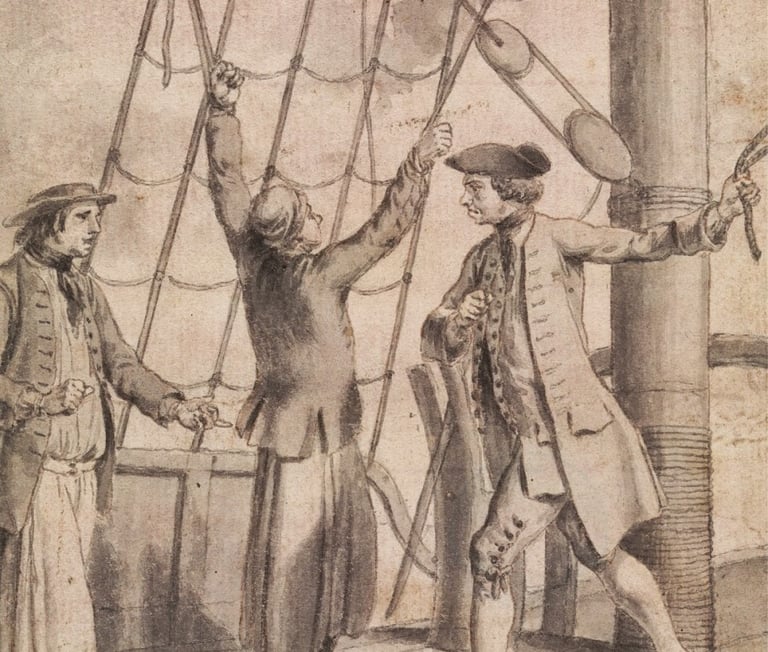
Even when they were at sea, thousands of miles from home, convict ships were governed by British law.
Gary L. Sturgess
3/12/20266 min read
Unlike the ships which carried Soviet prisoners to the Siberian Gulag from the 1930s through to the early 1950s, the transportation of convicts to New South Wales in the late 18th and early 19th centuries, was governed by law. [1]
Wagon trains making their way across the Overland Trail in the middle of the 19th century, were obliged to establish their own governments, having moved beyond the boundaries of European society. [2] But this was not the case with British merchant ships bound for Botany Bay with convicts and stores.
Of course, the master of a ship on the high seas enjoyed a great deal of autonomy. The courts recognised the unusual nature of his position, and the occasional need to assert his authority in order to maintain order, but this authority was grounded in law, and masters could be held accountable for abuse.
This paper (briefly) explores the sources and the limits of authority on board a convict ship. Unlike the hulks, there was no legislation granting the masters of convict transports the same powers over prisoners as sheriffs and gaolers, so where did their authority to punish, and in some cases, to execute a prisoner come from?
Crew
The captain’s authority to discipline his crew arose out of the master-servant relationship created by the articles of agreement, signed by the men when they first came on board. By this contract of employment, they bound themselves to ‘obey the lawful commands of their officers’.
But Charles Abbott, the early 19th century authority on maritime law, stated that his authority also came out of the Common Law:
'In case of disobedience or disorderly conduct, he may lawfully correct them in a reasonable manner; his authority in this respect being analogous to that of a parent over his child, or of a master over his apprentice or scholar. Such an authority is absolutely necessary for the safety of the ship, and of the lives of the persons on board. But it behoves the master to be very careful in the exercise of it, and not to make his parental power a pretext for cruelty and oppression. . .' [3]
Except in the case of an active mutiny, masters were not permitted to take a man’s life, but even then, the courts required evidence that the safety of the crew and passengers was at risk.
'. . . if the master strike a mariner without cause, or use a deadly weapon as an instrument of correction, and death ensue, he will be guilty either of manslaughter or murder. . .' [4]
In situations of ‘actual and open mutiny’, taking a man’s life in resisting the threat to the safety of the ship became an act of self-defence.
There are cases where masters were fined excessive violence on the ship’s return, and one case in the 1770s, where the captain was executed for killing a crew member. But until the 1830s, British courts were reluctant to second-guess the decisions of a master made at sea unless the evidence of cruelty was overwhelming.
Richard Henry Dana, a Harvard law student who spent two years ‘before the mast’ in the 1830s, and went on to practice maritime law, acknowledged the need for master to have significant authority, but warned:
'It is on long and distant voyages, where there is no restraint upon the captain, and none but the crew to testify against him, that sailors need most the protection of the law. On such voyages as these, there are many cases of outrageous cruelty on record, enough to make one heart-sick. . .' [5]
Passengers
Little has been written about the master’s authority over the passengers. Dana explained:
'A passenger must submit to the reasonable rules and usages of the ship. He has no right to interfere with its discipline and internal regulations. Indeed, in a case of necessity, and for the order and safety of the ship, the master may restrain a passenger by force; but the cause must be urgent, and the manner reasonable and moderate.' [6]
There are a number of cases where the master put unruly passengers on short rations by way of discipline. The legal justification is unclear – possibly the law of necessity or an implied term in the contract.
The Ocean, a ship carrying convicts, settlers and provisions to Port Phillip in 1803, had great difficulty with some of the free passengers at Rio de Janeiro. The following account is from the third lieutenant on HMS Calcutta, which accompanied the Ocean:
A report being made by the captain of the Ocean that the settlers on board were continually in a state of riot, and they on their part complaining of tyranny against the Captain and his officers, caused a court of enquiry to be held, which terminated in sending a party of marines on board her for the remainder of the voyage. [7]
Convicts
Convicts were passengers and were subject to the master’s authority in the same way. While they were (generally) not free to come and go as they pleased, convicts were not slaves and neither were they classified as cargo for insurance purposes. [8]
The use of irons was to ensure the ship’s safety, not a form of punishment. Most of the male convicts were kept in leg fetters on the early convict transports until the ships had passed the Cape of Good Hope, when mutiny was no longer an option (because they had nowhere to go). Women and boys were not ironed, and neither were trusted male convicts who managed the other prisoners. In cases of misconduct, the fetters could be returned, and if necessary, heavy irons, bar irons or handcuffs used.
There was a reluctance to flog women, and other punishments such as cutting their hair, or confining them for a few hours in a wooden box or ‘coal hole’, were often used.
To my knowledge, the issue was never litigated, but the authority to physically discipline badly-behaved convicts probably arose out of the ‘contracts of effectual transportation’, which transferred legal title over the convicts’ service to the master prior to sailing. This was a left-over from the North American system of transportation, and it created a master-servant relationship between the captain and the convicts, which meant that he was legally entitled to exercise reasonable discipline, in the same way that parents could do with their children, teachers with their pupils and masters with their apprentices.
Mutiny was a different matter entirely: as with crew mutinies, the ships’ officers were entitled to defend themselves and the ship. The killing of men in the heat of an affray was clearly a matter of self-defence, but the master was also legally justified in executing one or two of the ringleaders to ensure ‘the future preservation of the ship’.
In such cases, it was wise for the master to call together a ship’s counsel or ‘cuddy court’, so that the decision was a formal one – a subject which will be dealt with in the next Catspaw.
In the case of convict deaths as the result of a mutiny on the outward voyage, there was a formal inquiry upon arrival in NSW. The earliest example seems to be that of the Albemarle, a Third Fleet ship, where the master had hanged two of the ringleaders following a violent uprising. The Judge Advocate, David Collins, wrote in his journal:
'They had at this time parted company with the other transports, and no other means seemed so likely to deter the convicts from any future attempt of the like nature.' [9]
__________________
[1] Martin J. Bollinger, Stalin’s Slave Ships, Annapolis: Naval Institute Press, 2003.
[2] John Phillip Reid, Policing the Elephant: Crime, Punishment, and Social Behavior on the Overland Trail, San Marino, CA: Huntingdon Library, 1997.
[3] Charles Abbott, A Treatise of the Law Relative to Merchant Ships and Seamen, London: J. Butterworth, 1802, p.125-126
[4] Ibid., p.127.
[5] Richard Henry Dana, ‘Two Years Before the Mast’ [1840], in Richard Henry Dana, Two Years Before the Mast & Other Voyages, New York: The Library of America, 2005, pp.349-350.
[6] Richard Henry Dana, The Seamen’s Friend, Boston: Thomas Groom and Company, 1845, p.196.
[7] Nicholas Pateshall, A Short Account of a Voyage Round the Globe in HMS Calcutta, 1803-1804, Carlton: Queensbury Hill Press, 1980, p.50
[8] Jennie Jeppesen, ‘“Within the protection of law”:debating the Australian convict as slave narrative’, History Australia (2019) Vol. 16, No. 3, pp.534-548; Brown v Stapylton, Court of Common Pleas, Easter Term 1827, 4 Bingham 119, in Thomas Sergeant and John C. Lowber (eds.), Reports of Cases Argued and Determined in the English Courts of Common Law, Vol. XIII, Philadelphia: P.H. Nicklin and T. Johnson, 1839, pp.367-369.
[9] David Collins, An Account of the English Colony in New South Wales, London: T. Cadell, Jr. and W. Davies, 1798, p.181.
Contact us
Botany Baymen acknowledges the traditional custodians of country throughout Australia and respects their connection to land, water and community.
© Botany Baymen 2024-2026. All rights reserved.
You may download, display, print and reproduce this content for your personal or non-commercial use but only in an unaltered form and with the copyright acknowledged.
Privacy Policy

Subscribe to our latest updates
Be the first in the know. We promise no spam.