
How Major Ross Got His Job
Gary L. Sturgess
5/25/20265 min read
Historians have long been critical of Robert Ross, the Brevet Major who commanded the marines on Australia’s First Fleet and the colony’s first Lieutenant-Governor, dismissing him as churlish and disagreeable, having ‘totally failed to grasp his position’ and done ‘little or nothing towards the success of the new colony’, Governor Phillip’s ‘obstreperous bête noir’, ‘cantankerous and opinionated’, ‘recalcitrant’, ‘a tyrant’.
Which begs the question – how was he ever considered suitable for such a position of such great responsibility?
The answer lies in several articles published in the British press in 1789, shortly after the first news arrived home from the colony.
'Major Ross owed his civil promotion to the good offices of Sir John Jervis and Mr Nepean being commanding Marine Officer on board the Foudroyant when the former was Captain and the latter was Purser of that ship.' [1]
In the late summer of 1786, when the decision was made to establish a penal settlement at Botany Bay, Evan Nepean was the permanent secretary at the Home Office and the man who had done all of the detailed planning for the First Fleet. He had proven his administrative capabilities throughout the American War of Independence, rising from Captain’s clerk to Admiral’s clerk over the course of the war, and serving at various times as a ‘nip-cheese’ or ship’s purser. One of those ships was HMS Foudroyant, commanded by a young John Jervis, who recommended Nepean to the Earl of Shelburne when he was first appointed as Secretary of State in March 1782. Nepean quickly proved himself to be a master of public administration and bureaucratic politics.
Ross had served as the marine captain with Nepean on two ships, including Jervis’s Foudroyant, and his correspondence throughout 1786 and 1787 as the First Fleet was preparing to sail, suggests that the two men were relatively close at that time. Ross’s only son, Alexander John, was named after Jervis, and was known within the family as ‘John Jervis’.
There was a competing theory about Ross’s patronage, promulgated by his supporters in London, that he ‘owed his appointment’ to Major-General Arthur Tooker Collins, the officer commanding the marine division at Plymouth. [2] There is some contemporary evidence to support this: in a letter written from the Cape of Good Hope on the outward voyage, Major General Collins’ son David, who was a marine captain but going out to NSW as the Judge Advocate, acknowledged that his father had played a prominent role in Ross’s appointment.
But to understand what happened, we need to go back a decade earlier. Ross had served in the early stages of the American Revolution, leading the 5th company of marine grenadiers at the bloody Battle of Bunker Hill. While he was not in the hottest part of the fighting, four of his men were wounded that day. He returned home in 1777 and then spent 18 months recruiting at Cork, close to where his wife’s family lived.
He returned to active duty in June 1779, and was serving as the captain of marines on the Ardent on the 16th of August, when that ship was surrendered to the French after a heated engagement. He spent six months as a prisoner of war, and shortly after his return, gave evidence at a court martial which examined the conditions under which the ensign had been hauled down (signalling that she had surrendered). In the result, the captain was dismissed from the service because he ‘did not do his utmost to prevent the ship falling into the Enemy’s hands’. [3]
All of the other officers, including Ross, were exonerated, but evidence was given at the trial that he had come down from the poop deck and begged the captain to strike the colours. The 1st Lieutenant testified that he and every officer had objected to surrendering, ‘except for the captain of Marines’. While he had not been censured, Ross’s reputation was severely tarnished.
Clearly, someone still believed in him, because less than 12 months later, after another stint recruiting, he was appointed as the marine captain on HMS Foudroyant, widely regarded as ‘the crack ship of the navy’, under the command of John Jervis.
Late on the evening of 19 April 1782, during the Battle of Ushant, Jervis chased down a 74-gun French ship, Pégase, and after a hot engagement lasting an hour or more, captured her with not a single fatality on the Foudroyant. Accounts of the engagement are sketchy, but in his brief account, Jervis speaks of ‘close action’ which continued for three-quarters of an hour.
The Pégase was finally taken after a boarding party was sent aboard under the command of a young midshipman, Richard Bowen, who was Jervis’s aide-de-camp. (Almost a decade later, Lieutenant Bowen would sail to NSW as naval agent on the Third Fleet transport, the Atlantic, and name an inlet he discovered to the south of Port Jackson, Jervis Bay.)
In his account of the engagement with the Foudroyant, the French captain said that the ‘close action’ continued for some time:
'. . . finding that it was impossible for me to do any injury to an enemy whose swiftness rendered all my movements useless, I directed, as my last resource, to board my adversary, flattering myself, that by that manoeuvre I might be, perhaps, so fortunate as to damage their masts, and to escape by disengaging myself, if the hazards of boarding happened to be in my favour; but nothing happened as I wished. The two vessels remained grappled near an hour and a half, fighting with their musquets.' [4]
The marines were the light arms specialists on board a ship of war, trained in firing the ‘Brown Bess’ musket from the poop deck of a rolling ship, loading and firing again and again. Their role in close action combat of this kind was to maintain suppression fire on the upper deck of the enemy ship and to target the gun ports and take out the leading gunners. They were not generally included in boarding parties, but used to provide cover for the men who were charged with taking the enemy ship. Robert Ross was on the poop throughout the hottest part of this engagement, organising and directing his men.
In September 1782, the Foudroyant was in action yet again, contributing to the relief of Gibraltar, and exchanging fire with the enemy in what proved to be a glancing encounter at the Battle of Cape Spartel. While the marines played no direct role in this engagement, two of Ross’s men were killed and several wounded by cannon fire.
There can be no question that Jervis was deeply impressed with his performance in the capture of the Pégase, and a year later, in April 1783, Ross was promoted to Brevet Major.
Ross’s commanding officer, Major General Collins, must have played a significant role in his appointment to the NSW command, but without a disciplined performance on board the Foudroyant on the night of 19 April 1782, and a glowing reference from Jervis, it is likely that he would have still been tainted by his performance on the Ardent.
And, given that the officer commanding the marine garrison at Botany Bay was also to serve as the Lieutenant-Governor, a civil office, there can be no question that Nepean (and Jervis) played a key role in his appointment.
As it turned out, they were wrong about Ross. While his behaviour was not as woeful as historians have claimed, he had little leadership experience above the level of a ship’s detachment, and his inability to engage with Governor Phillip and his own officers directly contributed to his fall. [See Newsletter, The Decline and Fall of Robert Ross.]
____________________________
[1] Oracle, 25 June 1789
[2] Morning Star, 6 July 1789.
[3] Court Martial of the Ardent, 2-7 March 1780, UK National Archives, ADM1/5315.
[4] Chevalier de Silaus to the Marquis de Castries, Minister of the Navy, Morning Chronicle, 23 May 1782.
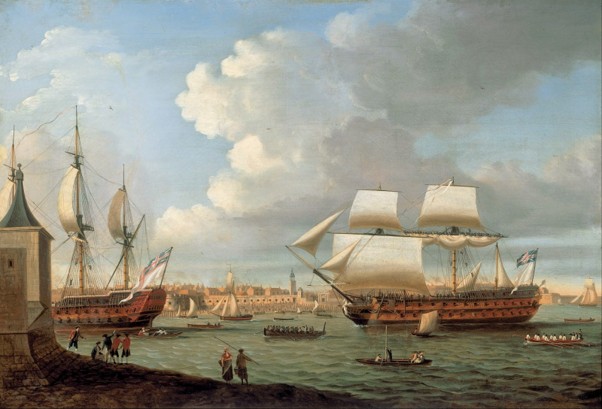
Dominic Serres, ‘Foudroyant and Pégase entering Portsmouth Harbour, 1782’, 1782, Art Gallery of South Australia
Contact us
Botany Baymen acknowledges the traditional custodians of country throughout Australia and respects their connection to land, water and community.
© Botany Baymen 2024-2026. All rights reserved.
You may download, display, print and reproduce this content for your personal or non-commercial use but only in an unaltered form and with the copyright acknowledged.
Privacy Policy

Subscribe to our latest updates
Be the first in the know. We promise no spam.