
Governor Phillip Flogs a Whistleblower
Gary L. Sturgess
6/2/20266 min read
R v Parr
In May 1788, William Parr, a merchant’s clerk transported to NSW for forgery, was sentenced to 200 lashes for spreading false stories and interfering in matters that were not of his concern.
Parr was literate and numerate, which made him valuable in a penal society short on men with clerical or supervisory skills. Shortly after coming ashore in late January 1788, he had been used as a camp overseer, and by late April, he was employed in the government storehouse, assisting with the issuance of spirits.
On the 29th of April, John Easty, a marine sentry overseeing the spirits being handed out to the detachment, noticed a convict leaving with a bottle of liquor and drew it to his sergeant’s attention. Parr explained to their satisfaction that it was for the carpenters working at the hospital.
Parr later told Easty that he was right to be suspicious: there were several people working at the storehouse who were doing wrong, but more seriously, the marines were being systematically cheated. They were not being issued with the quantity of provisions specified in the Governor’s directions – he had personally seen the written order – and the provisions served were of the poorest quality.
Easty took the matter to his commanding officer (either the captain of his company, James Meredith, or the officer commanding the garrison, Major Robert Ross), and Ross raised it with the Governor. Statements were taken, and David Collins, who was the Governor’s official secretary as well as the Judge Advocate, issued an opinion:
'The Battalion of Marines have no cause for Complaint respecting their Ration of Provisions issued by the Commissary. On comparing the Ration issued on Board the King’s Ships, it appears that the Ration of Bread & Beef, is the same. . .'
Then, in his capacity as Chief Magistrate, Collins (acting alone) found Parr guilty of:
'. . . interfering in a Business he had no concern in, for groundlessly insinuating to the Centinel on Duty, that the worst Provisions were issued to them, and for attempting to sow discontent among the Battalion by falsely asserting they did not receive their just Ration of Provisions.'
He was sentenced to be given two hundred lashes, a penalty which the Governor formally approved. [1]
The Eighths
I have long been aware of R v Parr, and it has always seemed odd. But yesterday, in researching complaints by the First Fleet marines about their provisions, and in particular, a decision taken by the Governor soon after landing to cut their rations by an eighth, the Sydney historian, Michael Flynn, reminded me of it.
It turns out that, while he did not fully understand what he had stumbled upon, Parr was right. And while he might have been guilty of sowing discontent (whistleblowers usually are), the allegations were true.
The marines were certainly discontented. At some point in the following days, the officers and enlisted men asked Major Ross to meet with the Governor to clarify what was going on.
The Governor acknowledged that the Commissary had been withholding an eighth from their rations since the 26th of February, when provisions were first issued from the government storehouse. This was, he said, ‘the custom of the Navy’, and it had been done ‘by particular directions from the Navy Board’.
Phillip was referring to a naval convention known as ‘the eighths’ or ‘the purser’s pound’, where the purser would withhold an eighth of the specified rations to make up for the shrinkage that often occurred when salted meat was packed into barrels and dry provisions were issued in small quantities. The Navy Board’s view was that pursers shouldn’t be accountable for these losses, but the purser’s pound, which weighed only 14 ounces (out of the 16 ounces in a pound), had become a perk of the job. Seamen sometimes complained about this, but it was an old practice and their rations had long been set based on the eighths.
Ross told Phillip that this was the first he had heard of the eighths being applied to the men on shore. Marines might be placed on short allowance by a general order, and if the Governor thought fit to give such an order, he would answer for the detachment ‘without a murmur’. But without such an order, the men would never be satisfied with 14 instead of 16.
Phillip said that he would write home to clarify the situation, and if he was wrong, the full rations would be reinstated and the marines compensated. [2]
Understandably, the men were not happy at the prospect of spending another 18 months on short rations, and over the following months, further inquiries were made. It emerged that the relevant instructions stated that the marines and convicts should be victualled ‘in the same manner as troops serving in the West Indies’. Ross had men in the garrison who had served in the West Indies, and they made it clear that the deduction of eighths was not part of those rations.
Ross met with Phillip again, and at some point between July and September, Phillip relented. The full allowance was reinstated – for convicts as well as marines. When the Lady Juliana arrived in June 1790, she brought a letter from the Home Office confirming that Ross had been right. [3]
Analysis
Several aspects of this affair are of interest. On the most favourable interpretation, Phillip had made a serious mistake, on a subject that was always of great concern to the marines (and the convicts).
Prior to sailing for NSW, the marines had protested about the government’s proposal to deprive them of spirits for the three years they were in the colony. On the 8th of May, five days before the fleet sailed from the Solent, Phillip and Ross had forwarded these petitions to the Home Office and the Admiralty, warning of ‘disagreeable consequences’ if the orders were not changed. Phillip received a reply two days later, authorising him to purchase wine and spirits at one of the ports on the outward voyage. [4]
Rations were only slightly less sensitive than spirits. As a naval captain, Phillip understood this, but he adopted the eighths without instructions directing him to do so, and without advising the officers of marines that he was proposing to do so.
He did not have ‘particular directions’ from the Navy Board to this effect, and the least critical interpretation of his actions is that without checking, he had concluded that the eighths was part of the rations usually issued to troops in the West Indies.
Which brings us back to R v Parr. If a convict working in the commissariat for only a month or two had figured out that the marines (and the convicts) were being short-changed, why were the commissary, the Governor’s official secretary and the Governor not sensitive to the inevitable controversy?
The marines were already suspicious: a note in the journal of Sergeant James Scott in mid-March recorded the recently introduced ration and noted the deductions, but made no comment, suggesting that he didn’t grasp what was going on. [5]
David Collins’ handling of the matter is unusual, to say the least. His certificate affirms that the marines were being provisioned the same as men on naval vessels and while he did note that deductions were made for shrinkage, he glossed over the central question – whether the marines on shore were bound by this naval convention. Collins was no fool, and he had served on shore as a marine officer during the early stages of the American War of Independence.
Then there is the fact that Collins sat as the sole judge in this case. It was usual for the Bench of Magistrates to involve at least two (although on occasions, Collins did sit on his own). Collins makes no mention of Parr's trial in his published journal, which deals with many of the cases which came before him.
Phillip then approved the judgement and the penalty, apparently without asking whether the convention of the purser’s pound applied to marines and convicts sent out to establish a new colony on the other side of the world, who would be supported by the Commissariat for a number of years.
R v Parr provides fascinating insight into how Arthur Phillip and his closest adviser managed the colony in the early months, and (to my mind) raises questions about their integrity.
___________________________
[1] R v Parr, 6 May 1788, Proceedings of the Judge Advocate’s Bench, 9 February 1788 to 14 November 1797, Museums of History NSW, NRS-3397-1-SZ767, pp. 21-23.
[2] Phillip to Nepean, 5 July 1788, Historical Records of Australia (hereafter HRA), 1:1, pp. 44-45; Ross to Stephens, 10 July 1788, UK National Archives (hereafter TNA), ADM1/3824/52a.
[3] Phillip to Nepean, 28 September 1788, HRA 1:1, p. 86; Phillip to Nepean, 16 June 1790, HRA 1:1, pp. 177-178.
[4] Ross to Stephens, 8 May 1787, TNA CO201/2/338; Phillip to Nepean, 8 May 1787, TNA CO201/2/150-150a; Nepean to Phillip, 10 May 1787, TNA CO202/5/39a; Ross to Stephens, 10 July 1788, TNA ADM1/3824/53-53a.
[5] James Scott, Remarks on a Passage to Botany Bay, 1787-1792, Sydney: Angus and Robertson, 1963, p. 37.
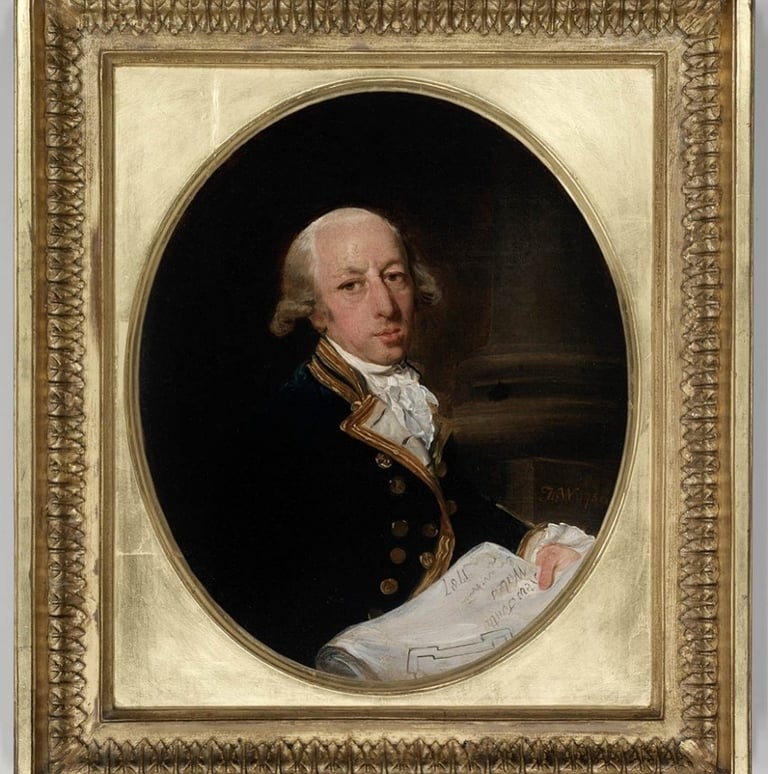
Francis Wheatley, Captain Arthur Phillip, 1786, State Library of NSW, ML 124
Contact us
Botany Baymen acknowledges the traditional custodians of country throughout Australia and respects their connection to land, water and community.
© Botany Baymen 2024-2026. All rights reserved.
You may download, display, print and reproduce this content for your personal or non-commercial use but only in an unaltered form and with the copyright acknowledged.
Privacy Policy

Subscribe to our latest updates
Be the first in the know. We promise no spam.