
Gauguin and the Spitalfields Weaver
Gary L. Sturgess
5/22/20264 min read


For reasons that are entirely understandable, Australian historians have focused on the convicts who stayed in the settlement at the end of their sentence. But in doing so, they have overlooked some fascinating stories that help us to understand the men and women sent to the far side of the world in the late 18th and early 19th centuries, their attachment to home, and the eagerness of some of them to experience the world.
Transported to NSW in 1819 for stealing, Thomas Bambridge spent several years working for Methodist missionaries in Tonga, at a time when this was a dangerous profession. After relocating to Tahiti around 1830, he founded a family dynasty which is scattered across the globe and regularly comes together to honour his name.
In 1818, Thomas Bambridge was a 16-year-old weaver living in Spitalfields, the cloth-manufacturing district of Greater London, when he and two of his workmates broke into a home in Fashion Court (in Spitalfields), and stole a number of articles. They were found guilty and sentenced to seven years transportation.
It was unusual to sentence a 16-year-old to transportation for a first offence, and while there is no evidence of prior convictions, one of his co-offenders had been in trouble with the law several years earlier, and it is likely that these boys were already known to the authorities.
At the age of 16, he was described as 5’2” tall and thin, with a ruddy complexion, brown hair and dark eyes. One his granddaughters would remember him as ‘tall and thin’, although at 23, he was only 5’8½” - which must have seemed tall to a little girl.
These three young men were transported on the Lord Sidmouth, arriving in NSW in March 1819. It is likely that Thomas had already shown a willingness to reform: on arrival, he was assigned to Captain John Piper, the colony’s Naval Officer, although he was probably working on his farm rather than in town.
Within a couple of years, Thomas was assigned to a time-expired convict, Thomas Sims, who was trading as a carpenter and builder. This enabled him to learn basic woodworking skills, which were in high demand in a pioneering society.
His sentence expired in May 1825, and in June of the following year, he presented himself to two Methodist missionaries who were about to embark for Tonga, to re-establish a mission there, and asked to join their company.
Reverend John Thomas later recalled that young Thomas Bambridge had been ‘seeking the Lord’ and tearfully begged them to take him, saying he would lose his soul if he stayed in Sydney. He was prepared to work for provisions and clothing, and after some hesitation, he was employed as an ‘artisan missionary’.
There had been several unsuccessful attempts at establishing missions on Tongatapu (as Tonga was then known). And a handful of escapees and time-expired convicts had lived among the islanders 20 years before, before being killed for failing to show respect to the local leaders. (See Catspaw, ‘A Convict Beachcomber’)
Reverend Thomas’s letters and journals document the difficult time which he and his fellow-missionaries had in their early years at Tonga, but they say little about Bambridge. It is evident, however, that he built the two-storey house with ten rooms in which Reverend Thomas and his family lived, as well as the chapel and other buildings, using cedar brought from NSW. The best source is the journal of Sarah Thomas, who mentions Tom the carpenter a number of times, making doors and coffins for the local chiefs.
At some point between 1828 and 1834, Bambridge relocated to Tahiti, where he married a young woman of noble ancestry, Mararea Connor. Maraea’s Irish surname came from her grandfather, James Connor, one of the crew of the whaler (and Third Fleet convict transport) Matilda, which had been wrecked on Mururoa Atoll in 1792. Connor had remained in the islands, fighting as a mercenary in tribal wars, and finally dying from battle wounds in 1804. (See Marion Amies and Gary L. Sturgess, ‘Competition, Conflict and Cooperation: The Voyage of Matthew Weatherhead’, The Great Circle, (2025) Vol. 47, No.1, pp. 58-79)
AI enhancement of a family photograph of Thomas Bambridge, (AI wrangler, Galen Sturgess)
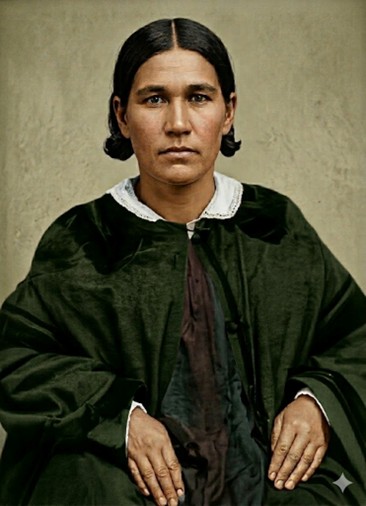
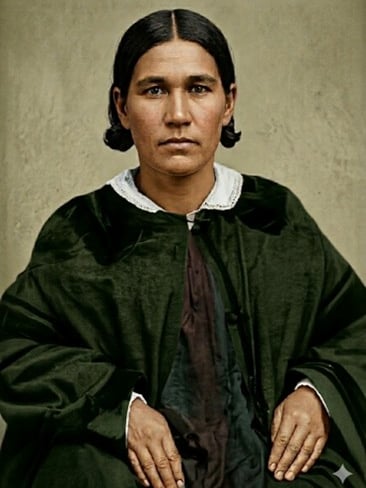
AI enhancement of a family photograph of Maraea Connor (AI wrangler, Galen Sturgess)
Bambridge continued to work as a carpenter and acquired property on the island, and according to his descendants, remained a devout Christian. The couple had at least 17 children, and possibly as many as 22. He passed away at the family home in the Rue des Beaux-Artes in Papeete in 1879, at the age of 78, and Maraea two years later.
Several of their boys worked in the building trade, Ebenezer as a carpenter and John as a house painter. One of their daughters, Suzanne Bambridge, became a leading social figure in Tahiti in the late 19th century, and was painted by Paul Gauguin in 1891, his first commission in the islands. Her pose is said to be based on a visiting card of Queen Pomare IV which was popular at the time.
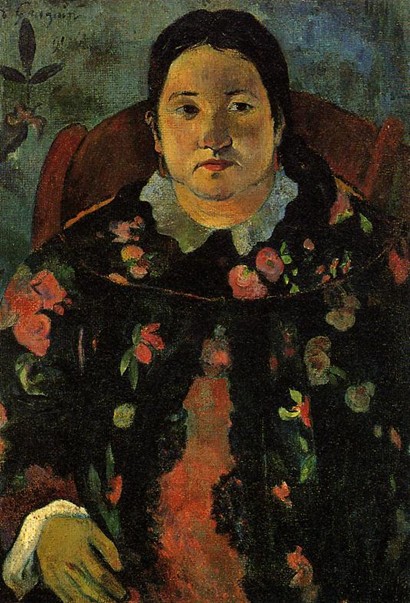
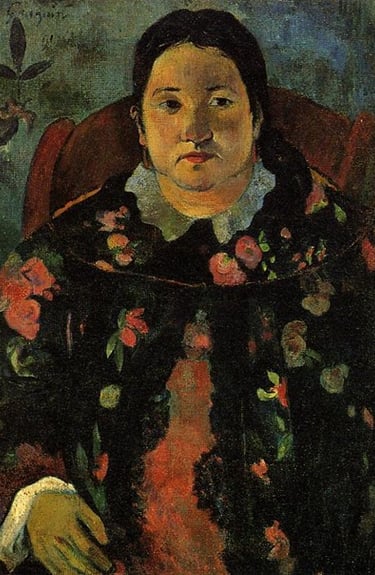
Paul Gauguin, Portrait of Suzanna Bambridge, 1891, Royal Museums of Fine Arts Belgium (Brussels), inv. 4491, photography by J. Geleyns
Thomas's and Maraea's descendants have been researching their history and holding family reunions since the late 1980s. In the past, some of the family embellished Bambridge's background, but as with convict descendants in Australia today, the current generation are relaxed about the reason he found himself in the South Pacific.
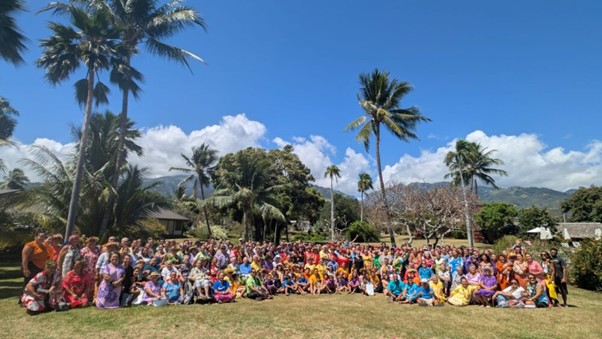
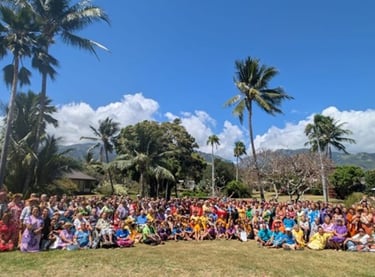
The Bambridge Family Reunion, Tahiti, 14-21 September 2025, photograph by Thomas Chabrol, Tahiti Nui Télévision
Contact us
Botany Baymen acknowledges the traditional custodians of country throughout Australia and respects their connection to land, water and community.
© Botany Baymen 2024-2026. All rights reserved.
You may download, display, print and reproduce this content for your personal or non-commercial use but only in an unaltered form and with the copyright acknowledged.
Privacy Policy

Subscribe to our latest updates
Be the first in the know. We promise no spam.