
Forgotten First Fleeters 3: Harry Brewer
Gary L. Sturgess
6/21/20269 min read
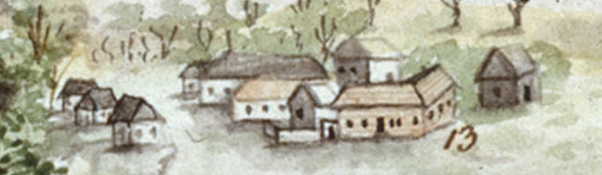
Henry Brewer has not been entirely forgotten, but his importance to the early colony has been greatly under-appreciated. Mollie Gillen included a brief entry in her biographical dictionary of the First Fleet – she mentioned his appointment as Provost Marshal, without explaining the significance of that position, and observed that he had worked as a house carpenter, without spelling out the extent of his contribution as Superintendent of Works. The Australian Dictionary of Biography has little more.
Harry (as he was known to contemporaries) was born around 1743, possibly in London (although Brewer is a common west country name). He was trained as a house carpenter, studied architecture to some extent, and worked as a ‘clerk’ for a large building firm.
And then, at the age of 35, for reasons that were not understood by his contemporaries, he changed career, joining HMS Alexander as a landsman. His carpentry skills would have been of great value on a wooden sailing ship, but he was literate, and the 1st Lieutenant, Arthur Phillip, took him on as his clerk. He would follow Phillip through a succession of postings, eventually joining him on his historic voyage to New South Wales.
Edward Spain, one of his shipmates on HMS Europe, which Phillip took to Madras and back in 1783, described Brewer as follows:
'. . . a man about fifty years of age of coarse harsh features, a contracted brow which bespoke him a man sour’d by disappointment, a forbidding countenance, allways muttering as if talking to himself. How shall I describe his dress? a blue coat of the Coarsest cloth, a wool hat about three shillings price cock’d with three sixpenny nails a tolerable waiscoat, a pair of Corderoy breeches, purser’s stockings and shoes a Pursers Shirt none of the cleanest, for his custom was to get a Shirt, a Pair of Stockings and shoes from the Purser and when the shirt was dirty, the stockings wore into holes or the shoes giveing way, to send the boy that tended on him (for he messed by himself) to the steward room saying, my Master wanted a new shirt a new Pair of Stockings and shoes of this size and here is the old ones, which was immediately comply’d with. He once said to the Midshipman whose father lived in old street: Come child, I will show you my chest – at one end there was a dirty shirt, at the other end a case bottle without a nose, a broken tea cup and a peice of raw salt Pork and a broken platter with some salt out of one of the Beef casks' (punctuation added). [2]
In 1783, Harry was only 40 years of age, so it is possible that he was prematurely aged by sun and spirits. Spain told several yarns about his drinking exploits:
'. . . one night when we were at sea, Harry had got his allowance not so bad but he found his way to the Gun room but could not raise purchase enough to get into his hammock so he contentedly lay down between the two after guns. It happened that day the Carpenters had been caulking the gun room and pay’d the seams with Pitch and not only the seams but some part of the planks; however Harry lay down and slept as happy as if in a down bed. In the middle of the night, there was four strange sail appear’d in sight. All hands were call’d to Quarters, and clear ship for action. The men that came to their Quarters in the Gun room with much adoe wak’d Mr Brewer, who endeavourd to get up but could not. He thought somebody held him, they says Mr Brewer get up, here is the Lieutenant comeing. Harry still thinking that someone held him say Poh! Poh! Don’t be foolish. At length two of them takeing hold of each arm pull him from the deck where he had stuck fast to the pitch, and there the patch a hands breadth remain’d on his coat to the end of the Voyage. . .' (punctuation added). [3]
When Phillip was appointed as captain of HMS Sirius and Governor-designate of the proposed new colony at Botany Bay, he brought Harry on board as a midshipman and arranged for him to be commissioned as marshal of the proposed Vice Admiralty Court. When the man who had been nominated as Provost Marshal of the intended colony failed to appear, Brewer was appointed in his stead.
Harry’s associates on the outward voyage are evident from a will which he prepared while the fleet was at the Cape of Good Hope. His estate was left to Andrew Miller, the intended Commissary and Registrar of the Vice Admiralty Court, who was another of Phillip’s ‘followers’, having also served on the Europe. The witnesses were Phillip himself, Thomas Freeman, another older seaman who would be appointed as Miller's deputy; and Thomas Brooks, the Sirius’s boatswain, who had also been on the Europe. [4]
When Phillip shifted across to the Supply several weeks after leaving the Cape, with the intention of sailing ahead of the fleet to make preparations for their arrival, Harry was one of the men he took with him. He was formally appointed as Provost-Marshal on their first day ashore, and it is likely that he was present at the historic flag-raising ceremony that afternoon.
Provost Marshal
The office of Provost Marshal was originally a military one, responsible for arresting riotous soldiers, investigating crimes and managing detention facilities. They also regulated the markets which grew up alongside military camps.
However, in the British colonies of North America and the West Indies, and later in New South Wales, civil officers were given this title, with responsibility for maintaining order, enforcing curfews and conducting criminal investigations, regulating trade and seizing illicit goods, and executing writs, impounding property and carrying out the sentences handed down by the courts, including the oversight of floggings and executions.
These responsibilities took on a somewhat different meaning in a community where the great majority of residents were convicted criminals, and shortly after his appointment, two constables (also known as ‘headboroughs’ or ‘peace officers’) were appointed to assist him – James Smith, a free man, and James Bazley, a convict.
Brewer’s first responsibility was to keep the convicts within the lines of settlement which had been laid down on the first day ashore, and to search for stragglers and escapees. Given the extent of these ‘lines of limitation’ and the small number of men at his disposal, this was an impossible task.
The constables (and occasionally Brewer himself) enforced the curfew and ensured that fires in the convict camps were extinguished. They were charged with enforcing the prohibition on convicts selling their government-issued clothing, and the seizure of spirits brought ashore in breach of the regulations by the sailors of visiting ships.
They searched the accommodation of convicts accused of stealing and detained them for examination by the magistrates. On occasion, Harry was personally involved in dealing with the drunk and disorderly.
In the winter of 1790, when some of the convicts were short-changed by the purser of the Neptune, who was managing a shop established by her captain on shore, they took their complaints to Harry Brewer. He tested the weights, insisted that the shop use an approved set of brass ones, and ordered that the disgruntled customers be compensated.
When some of the convicts who had arrived with Second Fleet complained that their valuables had not been returned by the ships’ officers at the end of the voyage, it was Harry Brewer who went on board and obtained redress.
He conducted the investigations for coronial inquiries. He enforced court orders. He presided over the first hanging in the colony, personally placing the halter around the neck of Thomas Barratt and ‘turning him off’. Thereafter, a convict was found to perform the office of executioner, but hangings and floggings were still overseen by Harry Brewer.
The Provost Marshall’s high standing in the early colony is evident from the fact that Brewer’s marquee was located on the eastern side of the stream, close to the Governor’s prefabricated house and alongside the marquees of the Commissary, the Judge Advocate (who was also the Governor’s official secretary) and the Surveyor-General.
Superintendent of Works
The Home Office had neglected to send out civilian overseers to supervise the convict workers, and Phillip had no alternative but to rely on some of the more responsible prisoners to oversee the various gangs, ‘people selected from among themselves being recommended by their conduct during the voyage’. [5]
In some cases, these were men with trade skills – brickmakers and bricklayers, stone cutters and stone masons, sawyers and carpenters, and so on. In other cases, they were men who had shown some aptitude for leadership, and a willingness to set themselves apart from their fellows, by giving orders and ensuring the men remained at their assigned tasks.
The gang working at the Brickfields could be given monthly production targets and held to account, and responsibility for the construction of individual huts and houses could be assigned to a gang engaged on a piece work, but some building projects were more complicated and took many months to complete. The marine barracks and the storehouses are obvious examples.
In these cases, a number of different gangs would be involved: planning and coordination were required, with work assigned to the various overseers on a daily basis. Project management of this kind was not done by the Governor and his official secretary. Responsibility was delegated to supervisors such as Harry Brewer, who had the requisite experience.
In May 1788, Phillip wrote that Brewer was superintending ‘the different works going on’, and in July he described this part of his responsibilities as ‘superintending the carpentry’, which is somewhat of an understatement. [6]
The clearest example of Brewer’s contribution as superintendent of works is to be found in his appointment in August of that year to oversee the completion of the marine barracks. Three of the four barracks had been delayed because of the refusal by some of the captains to supervise convict workers, which they saw as outside the scope of their duties, and the inability of the ships’ carpenters, four of whom had been assigned to the marine companies, to organise the convicts and coordinate their efforts with the marine artificers.
Harry Brewer had design skills (Major Robert Ross called him ‘the Architect’), he understood what was involved in building a house, and he had experience in project management. As Provost Marshal, he also had the authority to deal with stragglers and malingerers, and as a civilian, he was willing to issue instructions to the various convict overseers in a way that most of the marine officers would not.
Later Life and Death
Harry contemplated going home with the Second Fleet in late 1790 but was prevailed upon to stay. And when Phillip left the colony in December 1792, he elected once again to stay. Henry Waterhouse, who had been a young midshipman with Harry on the Sirius in 1787, wrote home to Phillip in late 1795: ‘Brewer plods on in the old way’: workmanlike and reliable. [7]
Like most First Fleeters, Harry would have suffered in the first year or two with periodic bouts of dysentery and persistent low-level scurvy, and like so many of them, his constitution was no doubt weakened by long periods of illness. By February 1796, when he was 52 or 53 years of age, Harry was so unwell that another man was appointed to act in his place as Provost Marshall. He passed away four months later.
A second will, executed in March 1796, tells us a great deal about the kind of men he socialised with in the colony. Andrew Miller had died on his way home in 1791, and under Harry’s new will, his estate was left to ‘my trusty and good friend Mr. Shadrach Shaw of Sydney’. [8]
Shaw was a former Bank of England securities clerk shipped out in 1792 for a fraud on his employer and immediately engaged to advise the Acting Governor, Francis Grose, who had taken over from Arthur Phillip, and the Adjutant of the NSW Corps, on financial matters. He had been pardoned in late 1792, and while he remained close to the administration, he had established a substantial warehouse and general store in the government precinct on the eastern side of the stream.
The witnesses to this new will were three free settlers: Thomas Smyth, a former marine sergeant who was serving as the government storekeeper at Sydney; Maurice Margarot, one of the so-called Scottish Martyrs, who had been sent out in 1794 as an exile rather than a convict; and Daniel Paine, the government ship-builder.
Harry Brewer belonged to a class of public servants who were vital to the early success of the colony – the commissary and his assistant, the storekeeper, the shipbuilder, and a clerk at Government House – who are mentioned only in passing by Phillip and Collins, and have been given scant attention by historians.
____________________________________
[1] Port Jackson Painter, 'A View of Sydney Cove - Port Jackson March 7th 1792', UK Natural History Museum, Watling Drawing No.21.
[2] Edward Spain, ‘Reminiscences’, State Library of NSW (hereafter SLNSW) SAFE/C266.
[3] Ibid.
[4] Will of Henry Brewer, 1 November 1787, UK National Archives (hereafter TNA), ADM48/4/28.
[5] David Collins, An Account of the English Colony in New South Wales, London: Cadell and Davies, 1798, p. 9.
[6] Phillip to Sydney, 16 May 1788 and Phillip to Nepean, 9 July 1788, Historical Records of NSW, 1:2, pp. 139 & 154.
[7] Waterhouse to Phillip, 12 September to 24 October 1795, SLNSW, Sir Joseph Banks Papers, Series 37.28.
[8] Will of Henry Brewer, 11 March 1796, TNA Prob 11/296.
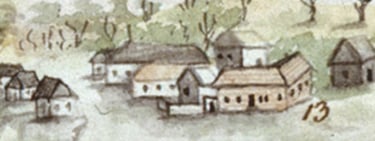
The military precinct, Sydney Cove, February 1792, showing the barracks project-managed by Harry Brewer [1]
Contact us
Botany Baymen acknowledges the traditional custodians of country throughout Australia and respects their connection to land, water and community.
© Botany Baymen 2024-2026. All rights reserved.
You may download, display, print and reproduce this content for your personal or non-commercial use but only in an unaltered form and with the copyright acknowledged.
Privacy Policy

Subscribe to our latest updates
Be the first in the know. We promise no spam.